
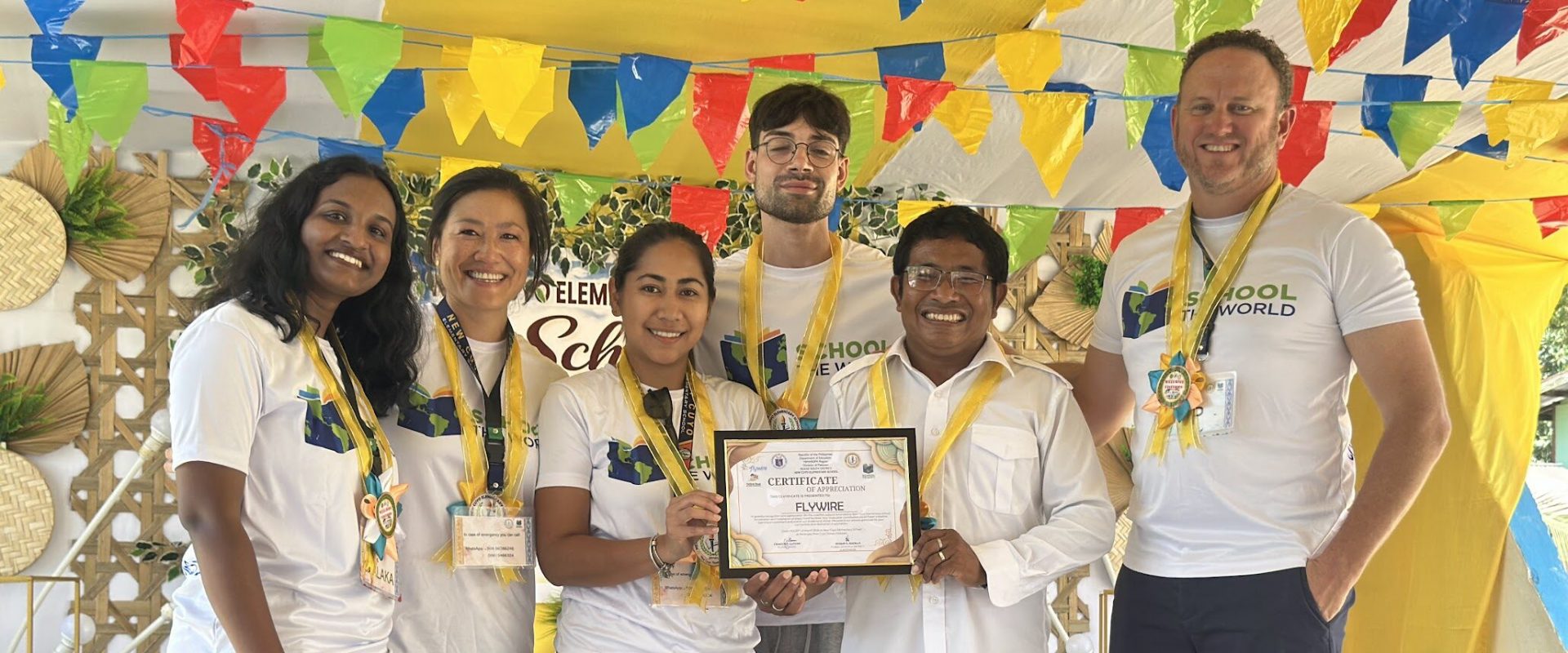
At School the World, we build classrooms in some of the most under-resourced communities in Central America and the Philippines, and we can’t do it alone. Every school we build depends on partners who are willing to show up, literally, with paint brushes and shovels in hand.
Nearly eight years ago, our founder and CEO, Kate Curran, met Flywire‘s CEO, Mike Massaro. That personal connection turned into something much bigger. Mike became personally invested in our mission, and so did his wife and family. He helped organize and galvanize the first group of FlyMates (Flywire’s name for its employees) to join us on a service trip. As Sarah King, who leads impact and ESG efforts at Flywire, told us: “It’s been part of our kind of ethos for a really long time… FlyMates who go on these trips come back saying this changed my life.”
That first trip has grown into a partnership that’s helped us build 14 classrooms and 7 playgrounds through our corporate partnerships, with over 50 FlyMates having traveled with School the World over the years and hundreds more supporting their colleagues through financial donations. They were also the first company, in 2026, to sign on and innaugurate our service trips to the Philippines with Flymates from Asica offices.
Flywire is a payments and software company in the fintech space, headquartered in Boston with 11 offices around the world. It was founded by an international student who had a frustrating experience paying his own tuition at MIT, and that problem became the company’s founding mission. Today Flywire has grown well beyond education payments into healthcare, travel, and B2B industries, serving over 5,000 clients worldwide. The company went public on NASDAQ in 2021 and now employs 1,400 people representing 45 nationalities and more than 60 spoken languages. That global, people-first identity shows up in how Flywire treats giving back.
More Than One Way to Give
School the World trips are the most visible part of Flywire’s giving, but they’re one piece of a broader culture. Every FlyMate gets two paid “FlyBetter Days” a year to volunteer however they choose. In Boston, it meant volunteering together at a community farm, and packing and prepping meals at St. Francis House. FlyMates logged more than 6,500 volunteer hours globally in 2024 alone.
Flywire also runs a donation-matching program that lets FlyMates give to any of over 2,000 nonprofit organizations and have Flywire match up to $100 per employee each year. During Giving Tuesday, that match doubled, and this past year it tripled, which drove a wave of donations to School the World in support of the Flymates traveling on the next service trip.
Getting to travel with School the World involves FlyMates applying by submitting a short essay on why they want to go and what impact they hope to have. A committee that includes Flywire executives and past trip participants scores every essay. Once selected, travelers are announced company-wide, with Flywire’s CEO personally recognizing them.
This year Flywire received 35 applications for its trip, a 100% increase over the prior year, for roughly 10 to 12 spots. Getting picked is only the start. Each traveling FlyMate is responsible for fundraising their own way, roughly $2,000 per person, on top of a corporate donation from Flywire directly.
What Flywire’s People Bring Back
We see the results of that selective, effort-based process on the ground. FlyMates who’ve earned their spot show up ready to work. Angelica Saggers, who travelled in March 2026, described mixing cement, pouring classroom floors, painting playgrounds, and designing murals during a trip to Tuluché, Guatemala. She called it small at the moment, but part of something much larger: a safe space where learning can happen and children are given the chance to build a different future.
Another FlyMate, Zheni Valiseva Yankova, a Junior Staff Accountant based in Valencia, shared this reflection after her own trip to Guatemala in 2025: “This trip has given us all a touch of humanity and modesty. The children, parents and teachers of that community are wonderful people, and my colleagues have all shown incredible values. I have been very lucky to share this experience with people like them.”
Angelica Saggers, a Corporate Development Associate based in Boston, who traveled to Tulutché I, also spent an afternoon in the home of a local family and met a mother named Angelica, her tocaya, or name-twin. Angelica’s home was a modest clay structure with no running water, with animals moving freely around the space. She showed the group her daily routine: washing dishes in two small basins, grinding corn by hand for tortillas while chickens wandered nearby. She’d spent three months hand-detailing a beautiful skirt for textile contract work, using tools and materials she doesn’t even own.
Angelica’s husband works away from home making clay for construction, while she stays back to raise their four children and hopes to contribute financially however she can. She grew up without access to formal education after losing her own mother as an infant.
Angelica also wrote about the children she met in the community more broadly, most of whom spoke their mother-tongue, Quiché, or Spanish. Despite the language barrier, they communicated through drawings, gestures, and by pointing at objects, asking to learn the English words for them. She noted that school days ended early there, not for rest, but so the children could help their families, whether that meant textile work or walking 20 to 45 minutes each way to collect water.
This is the gap we exist to close: not a gap in talent or effort, but a gap in access, shaped by infrastructure and circumstance that families like Angelica’s had no hand in creating. Angelica S. put it plainly in her own reflection: “The gap I saw was not a lack of effort or ability. It was a lack of access shaped by systems, infrastructure, and economic constraints. That realization has made me think more critically about how opportunities are created, distributed, and scaled.”
Sometimes the clearest sign a partnership is working is watching it spread on its own, past the edges of the company that started it. That’s exactly what happened with Brittni Bragg and her son Owen.
Brittni first heard about School the World from her colleagues at Flywire, where service learning has been part of the culture for nearly a decade. “I heard about how great the trip was from my colleagues who had gone on it,” she recalls. “They came back so enthusiastic about their experience.” She applied, built a full slide deck to make her case, and got selected to travel to Panama in March 2024
When Brittni came home, she told everyone, including her son Owen, then a student at North Andover High School. “What she told me about the kids, the experience, the people she got to see, it was really moving to me,” he says. Even so, it wasn’t a small ask for a teenager who’d never left the country. “I probably wouldn’t have gone by myself if it wasn’t for my mom,” he admits.
Owen decided to sign up for his own trip, this time through our Student Service Learning program, traveling to Panama. Fundraising for a student trip is no small task, and this is where the ripple effect really showed itself: donations came in not just from family and friends, but from former Flywire colleagues of Brittni’s who had never even met Owen, giving simply because they believed in the experience and wanted to pay it forward. “He raised the funds, but he also had the most donors,” Brittni says proudly. “It wasn’t one person dropping a big check. It was a whole bunch of $20 payments. A true community effort.”
Stories like the Braggs’ are why we don’t think of a corporate partner’s impact as ending at the office door. A single FlyMate’s trip turned into her son’s trip, which turned into an entire informal donor network of people who’d never set foot in Guatemala or Panama but wanted to be part of it anyway. That’s the kind of momentum a partnership like Flywire’s creates, one that keeps finding new people to pull in, long after the original trip is over.
When we thanked Sarah for Flywire’s continued support, her response summed up why this relationship has lasted nearly a decade: “It’s a really, really important part of our company. And it gives back to us more than we give to it.”
That’s the kind of partner we want beside us. Read more about participating in School the World Corporate Service Trips.
Join our newsletter and get the latest updates
By signing up, you agree to receive emails from School the World, Inc..