
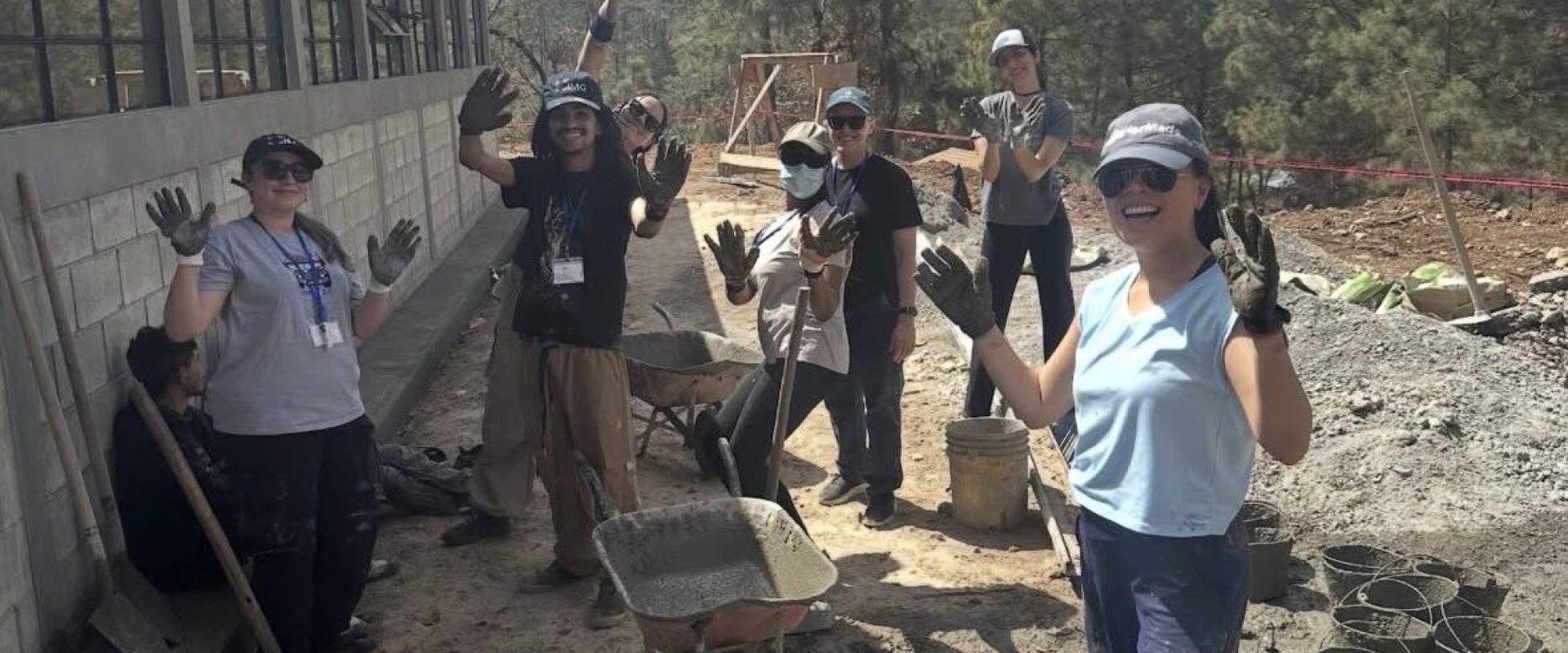
At 8am, I was on a bumpy car ride to a rural school in Tulutché, and by 9am I was mixing cement with a shovel alongside locals who had been waiting years for a classroom like this.
The work was physical and unfamiliar, but what stayed with me most wasn’t the labor, it was the people. Many of the locals we worked with hadn’t had access to formal education themselves, yet they showed up every day, committed to building that opportunity for their children. It was a powerful reminder that talent and curiosity are everywhere, but opportunity is not.
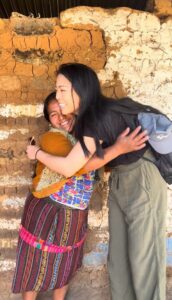 One of the most impactful moments of the trip was visiting the home of a local family with four children. There, I met the mother, my tocaya, Angelica. Her home was a modest clay structure without running water, with animals moving freely around the space, a completely different standard of living than what I’m used to. She welcomed us in and showed us her daily routine. She cleaned dishes by hand using just two small basins and a limited water supply. She then let us try grinding corn on the ground to make tortillas, with chickens wandering nearby. Before we left, she showed us a beautifully detailed skirt she had been working on for the past three months. Angelica shared that her husband works away from home making clay for construction, while she stays back to care for their children. She hopes to contribute financially, but her only option is to take on textile work through contracts where she doesn’t even own the materials or tools she uses. She also told us that her own mother passed away when she was an infant, and she grew up without proper education. Despite that, what stood out most was her determination for her children to have a different path. She spoke about wanting them to go to school and pursue the education she never had. As we were leaving, she asked if we could walk her children back to school with us to make sure they arrived safely. That moment stayed with me. It was a clear, personal example of what opportunity really means.
Having grown up across different countries, I’ve seen how uneven education can be. But seeing it up close in rural Guatemala made that reality impossible to ignore. Education, to me, has always meant more than academics, it’s about autonomy, the ability to shape your own future. Watching families invest their time and energy into something they may not have had themselves made that belief feel very real.
What surprised me most was the children. They were curious, confident, and eager to connect. Most spoke Quiché or Spanish, and my Spanish is limited at best, but that didn’t stop them. They found ways to communicate through drawings, gestures, and by pointing to objects, asking me to teach them the English words. There was no hesitation, only a genuine desire to learn. School days ended early, not for rest, but so the children could help their families, whether that meant making textiles or walking 20 to 45 minutes to collect water and carry it home. It made me reflect on how much I take for granted, even something as simple as access to clean water.
The work itself, mixing cement, pouring classroom floors, painting playgrounds, and designing murals, felt small in the moment. But together, those efforts contribute to something much larger: creating a safe space where learning can happen and where children are given the chance to build a different future.
Just as notable was the dedication of the local construction crew who worked alongside us during the day. Many of them were fathers of the students who would eventually learn in these classrooms. After we wrapped each afternoon, they continued working into the evening, ensuring the quality of the build and keeping the project on track. Their commitment went far beyond the scope of the project, it was deeply personal.
This experience also enabled me to connect more deeply with my colleagues, working side by side in a completely different context than our day-to-day roles. It was a reminder that meaningful work can take many forms, and that shared experiences like this create lasting bonds.I will carry the memories, lessons, and perspective with me for the rest of my life. The gap I saw was not a lack of effort or ability. It was a lack of access shaped by systems, infrastructure, and economic constraints. That realization has made me think more critically about how opportunities are created, distributed, and scaled.
For anyone considering a trip like this, be prepared to step outside your comfort zone in ways that are both physical and personal. You’ll be mixing cement, navigating language barriers, and engaging with families whose daily realities may look very different from your own. The impact isn’t just in what you help build, it’s in how the experience reshapes your understanding of access and opportunity, and challenges how you see the world and your place in it.
___________
To see Angelica and Angelica together, watch this video. You can also read more about our Corporate Service Trips.