
A fourth grader can sit in a fourth-grade classroom every day and still struggle to read a sentence. Another may recognize numbers but not yet know how to add or subtract them. Both are enrolled in school. Both want to learn. But the lessons taught at their grade level may assume skills they have not yet mastered.
These gaps are difficult for one classroom teacher to address, especially in a room of 30 or more students who are learning at very different levels. Without focused support, children can fall further behind each year. Reading assignments become harder to understand. Math builds on operations they never fully learned. Eventually, some students begin to believe that they simply are not capable learners.
School the World’s Accelerated Learning Program helps interrupt that pattern. Through an approach known as Teaching at the Right Level (TaRL), trained community tutors begin with what each child can do today and help that child move forward one skill at a time.
At the beginning of the program, every student completes a diagnostic assessment in reading and math. Instead of grouping children only by age or grade, tutors bring together students who need to work on similar skills. A fourth grader who is learning to read words can receive instruction designed for that stage, while another fourth grader may work on understanding paragraphs.
Tutors lead structured, small-group sessions five days a week. Short assessments throughout the year help them see when students are ready to move ahead or when they need more time. The groups can change as the children progress.
This matters because “catching up” is not one leap. It is a series of concrete steps. In reading, a child progresses from recognizing letters and sounds to reading words, sentences, paragraphs, and stories. In math, students move from recognizing small numbers toward calculating with numbers up to 1,000 and using addition, subtraction, multiplication, and division.
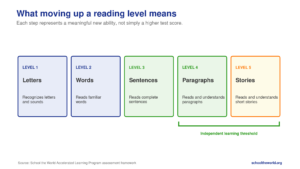
Chart 1. School the World’s five reading levels
School the World launched the Accelerated Learning Program in 2022, as students returned to classrooms carrying significant learning gaps from the pandemic. The first cohort received three years of tutoring, from 2022 through 2024. As the program continued and students returned to more stable school environments, the results showed that comparable progress could be achieved within two years. School the World adopted that two-year model for subsequent cohorts.
Since 2022, School the World has launched four cohorts across rural communities in Guatemala, Honduras, and Panama. Two cohorts have completed the program. Cohort 3, which began in 2025, is completing its second year in 2026, while Cohort 4 has begun its first. Altogether, more than 13,500 students have participated in tutoring since the program began.
With each cohort, School the World has used student results and tutor feedback to strengthen the program. The team has improved its assessments, expanded ongoing training and support for tutors, and adjusted the learning activities to address the skills students need when they enter the program. The central approach remains consistent: assess what each child can do, teach the next foundational skill, and track progress throughout the year.
The results from the first year of Cohort 3 show how much progress is possible. In 2025, approximately 93% of participating students advanced at least one reading level, and 94% advanced at least one math level.
The average student advanced two full reading levels in one year. For a child who began by recognizing letters, two levels of progress can mean reading complete sentences by the end of the year. In math, students advanced an average of 1.65 levels.
These measures describe changes in what students can do. They do not simply show that a test score went up. Each new level represents skills that allow a child to participate more fully in class and tackle increasingly complex work.
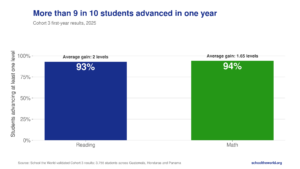
Chart 2. Cohort 3 first-year results, based on 3,755 participating students
School the World identifies Levels 4 and 5 as the independent learning threshold. In reading, students at these levels can read and understand paragraphs or short stories. In math, they can use the four operations with numbers up to 1,000 and begin working with fractions.
Reaching this threshold can change a student’s experience throughout the school day. Reading is no longer limited to sounding out individual words. The child can begin using reading to learn about science, history, and the wider world. In math, the student has the foundational operations needed to approach more advanced problems.
Among second graders participating in Guatemala, only 1.6% began 2025 at the independent reading threshold. By the end of the year, 40.8% had reached it. Among participating fourth graders, the share grew from 10.0% to 79.7%. In Honduras, the proportion of participating fourth graders at the independent math threshold increased from 13.8% to 64.8%.
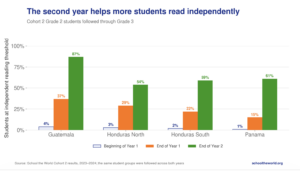
Chart 3. Selected examples of progress toward Levels 4 and 5
The percentage reaching Levels 4 and 5 tells an important story, but it does not tell the whole story. Children begin the program at very different points. In some communities in Panama, nearly every younger student began at Level 1. Many needed to develop pre-reading or pre-math skills before they could work on the material originally planned for their grades.
Those students still made substantial gains. Across Panama, approximately 97% advanced at least one reading level and approximately 97% advanced at least one math level. A child who moves from letters to sentences has made a meaningful leap, even if that child needs another year to read a story independently.
This is why the program measures both movement between levels and the percentage of students reaching the independent learning threshold. One measure shows how far children have traveled. The other shows how many have reached a key destination.
School the World follows the same students across the two years of each cohort. Results from Cohort 2 show why that sustained support matters. Among the students who began the program in Grade 2, the percentage reaching the independent reading threshold continued to rise through Grade 3 in every participating region.
In Guatemala, 4% began the program at the threshold. That figure reached 37% at the end of the first year and 87% at the end of the second. Panama’s group progressed from 1% at the beginning to 15% after one year and 61% after two. The Honduras groups also continued making substantial gains during their second year.
School the World initially designed its first post-pandemic cohort as a three-year intervention because students had experienced extensive learning disruption. As later cohorts progressed, the data showed that students in more stable school environments could achieve comparable results within two years. The program adopted a two-year cohort model, allowing more children to receive tutoring while preserving the time students need to build foundational skills.
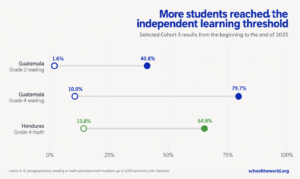
Chart 4. Two-year progress among the same Cohort 2 student groups
Understanding the results also helps School the World strengthen the program for subsequent students. Reading has generally advanced faster than math during the first year, particularly among younger students. In response, the team improved the math diagnostic, added training to strengthen tutors’ own math knowledge, and increased coaching during the first months of each cohort.
The assessment process has changed as well. Short reading and math checks now take about three minutes per student instead of approximately ten, preserving frequent progress monitoring while returning more time to instruction. Other program refinements have reduced the cost per student from approximately $50 to $28 while maintaining strong learning gains.
These adjustments reflect an important principle: the data is not collected only to describe what happened. Tutors and program leaders use it to decide what students need next and how the program itself can improve.
This year, the students in Cohort 3 are completing their second year of tutoring. At the same time, Cohort 4 has begun its first. The next round of results will show how many Cohort 3 students built on their first-year gains and reached the independent learning threshold, while a new group begins its own journey from letters toward stories and from recognizing numbers toward solving problems.
For each child, the journey looks different. The purpose remains the same: help students master the foundational skills that allow them to participate confidently in class, continue learning, and see themselves as capable of what comes next.
The 2025 results compare participating students’ initial and final assessments. They document progress during the tutoring period but do not use a control group to isolate how much progress resulted from tutoring versus regular schooling or other influences. “Independent learning threshold” refers to Levels 4 and 5 in School the World’s assessment framework and should not be interpreted as a nationally standardized grade-level proficiency measure.