
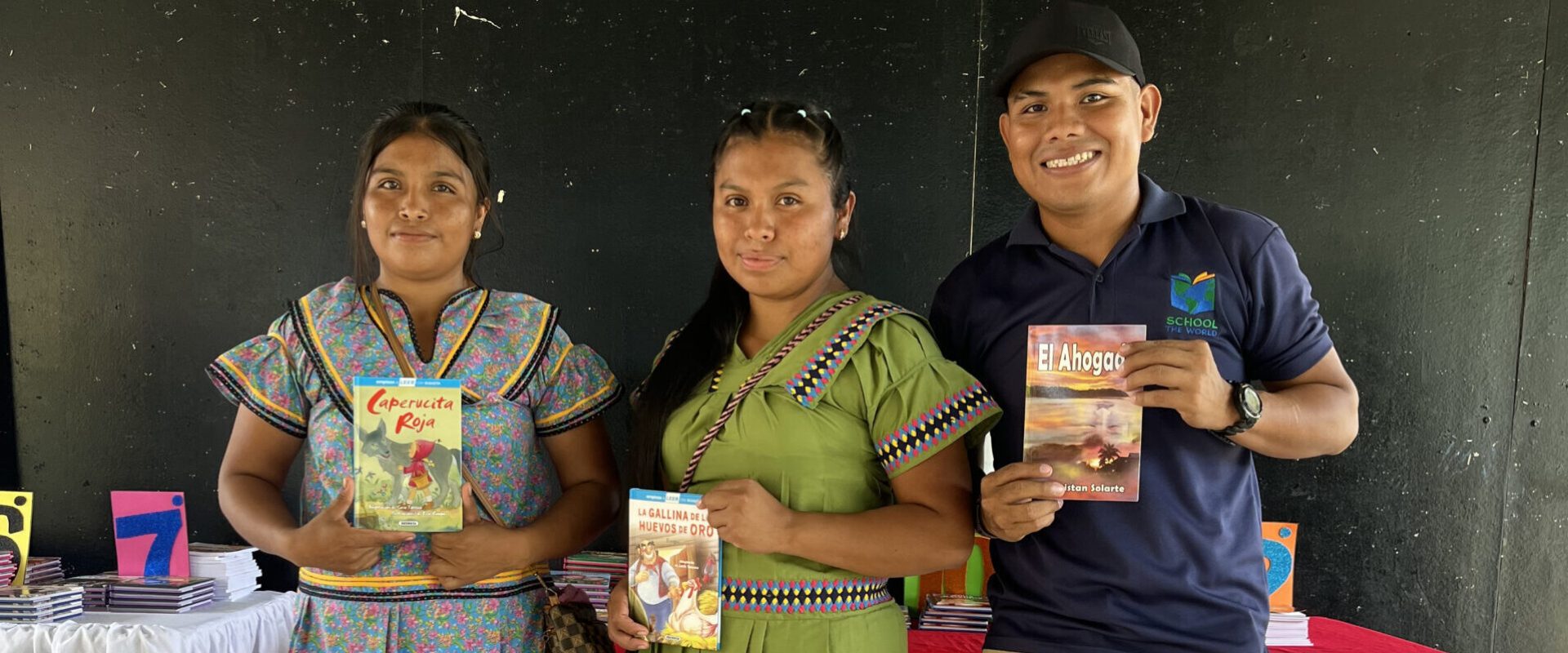
When Fabian Bejerano speaks with students in Panama’s Ngäbe-Buglé Comarca, he does not have to imagine what it means to grow up in an Indigenous community with limited resources. He has lived it.
Fabian trained as a primary school teacher and now works full time with School the World as a Change Agent. His background gives him an understanding of the circumstances surrounding a student’s education: the sacrifices families make, the difficulty of traveling far from home to continue studying, and the cultural importance of returning to contribute to one’s community.
That understanding shapes how he connects with students and families. He can draw on experiences they recognize, communicate with cultural familiarity, and offer encouragement grounded in a life that looks, in important ways, like their own.
It also illustrates why School the World invests in hiring local and Indigenous team members. They do more than deliver programs. Their knowledge and relationships help ensure that our work reflects the realities of the communities we serve.
School the World works alongside communities in the Ngäbe-Buglé Comarca in northwestern Panama. Created in 1997, the comarca is a legally recognized Indigenous territory in which the Ngäbe and Buglé people hold collective land rights and exercise considerable administrative autonomy through their own elected leaders and governing structures.
That sovereignty and cultural identity matter. Effective partnerships must respect not only the needs of individual communities, but also their knowledge, leadership, language, and ways of understanding education.
The region also faces significant economic and educational inequities. More than 90 percent of children in the Ngäbe-Buglé Comarca live in poverty, according to a recent World Bank analysis. Geographic isolation and limited access to infrastructure, services, and employment can make continuing an education especially difficult. The World Bank
Fabian knows those challenges personally.
Fabian grew up in an Indigenous community where economic limitations were a constant part of life. There were times when his family did not have money or some of the basic materials they needed.
To pursue his bachillerato and train as a teacher, Fabian had to leave his community and continue his studies in the city. The transition was difficult for him and his family, but it also introduced him to people and perspectives beyond those he had known growing up.
He studied alongside people from Guna, Emberá, and other communities, each bringing different cultures and ways of life. “Education is what has allowed me to experience different things and to see the world differently,” he said.
Today, Fabian can speak honestly with students about what continuing his education required. He does not minimize the financial, geographic, or emotional barriers they may face. Instead, he helps them see that leaving home to study does not have to mean abandoning their identity or community.
“I tell them that we study so that we can return, contribute, and help,” Fabian explained. “I have had to leave my community at times in order to study, but the goal is not simply to leave. Education can help us come back stronger, help our families, and support our communities.”
Because Fabian has made that journey himself, his message carries a different kind of credibility. Students are not only hearing that more may be possible. They are meeting someone who can show them what that possibility might look like.
One boy Fabian met illustrates why this understanding matters.
Whenever Fabian visited the boy’s community, the student would seek him out to talk and ask questions. Eventually, he told Fabian that both of his parents had died and that his grandmother was raising him.
When Fabian met her, he understood more fully what the boy was carrying. She was around 80 years old and had significant difficulty walking, but she continued attending School the World’s training because she felt responsible for helping her grandson move forward.
She told Fabian about the hardships they faced and her concern about what would happen to the boy when she became sick and could not care for him. Fabian saw the grandmother’s determination, but also the enormous responsibility she carried.
Despite everything the boy had experienced, he still believed in his abilities. “That may be what affected me most,” Fabian said.
Supporting a student in those circumstances requires more than telling him to work hard. It means understanding the family surrounding him, recognizing the support he may be missing, and helping protect his belief that his future can be different.
“Sometimes children hear people tell them that they cannot do something, and sometimes even teachers may discourage them,” Fabian said. “What impacts me most is seeing the needs a family lives with and recognizing how important it is to keep supporting and encouraging children.”
Fabian’s experience does not mean every student’s life is the same as his. It gives him a foundation for noticing what might otherwise be overlooked and asking questions that reveal what a student or family truly needs.
He understands that a family may value education deeply while still struggling to keep a child in school. He knows that leaving home can represent both opportunity and sacrifice. He recognizes that a student’s progress may depend on circumstances far beyond the classroom.
This knowledge helps School the World provide more responsive support. Local and Indigenous staff members can connect educational goals to examples families recognize, communicate with cultural credibility, and help programs adapt to the realities of each community.
They are not simply implementing work designed elsewhere. Their judgment, relationships, and lived experience help shape the work itself.
Fabian continues to pursue his education while encouraging students to pursue theirs.
After training as a primary school teacher, he studied primary education at the university level. He recently began a master’s degree and completed a postgraduate program in teaching methodology.
His goal is to keep strengthening his ability to contribute to quality education in Panama, particularly for communities like those he knows firsthand.
“Through my experiences, I have seen many needs, including the sacrifices families make,” he said. “I want to be part of that change and eventually teach from a different perspective, with a focus on quality education.”
Fabian brings professional training to his work, but he also brings something equally important: an intimate understanding of the communities School the World serves.
He can acknowledge the barriers students face without allowing those barriers to define what they can become. He can show them that pursuing an education does not require leaving their community or identity behind. It can prepare them to return with more knowledge, more choices, and more to contribute.
Fabian helps students see what education can make possible. His work also demonstrates why lasting change begins with people who know a community not only as a place where they work, but as part of who they are.
Join our newsletter and get the latest updates
By signing up, you agree to receive emails from School the World, Inc..