
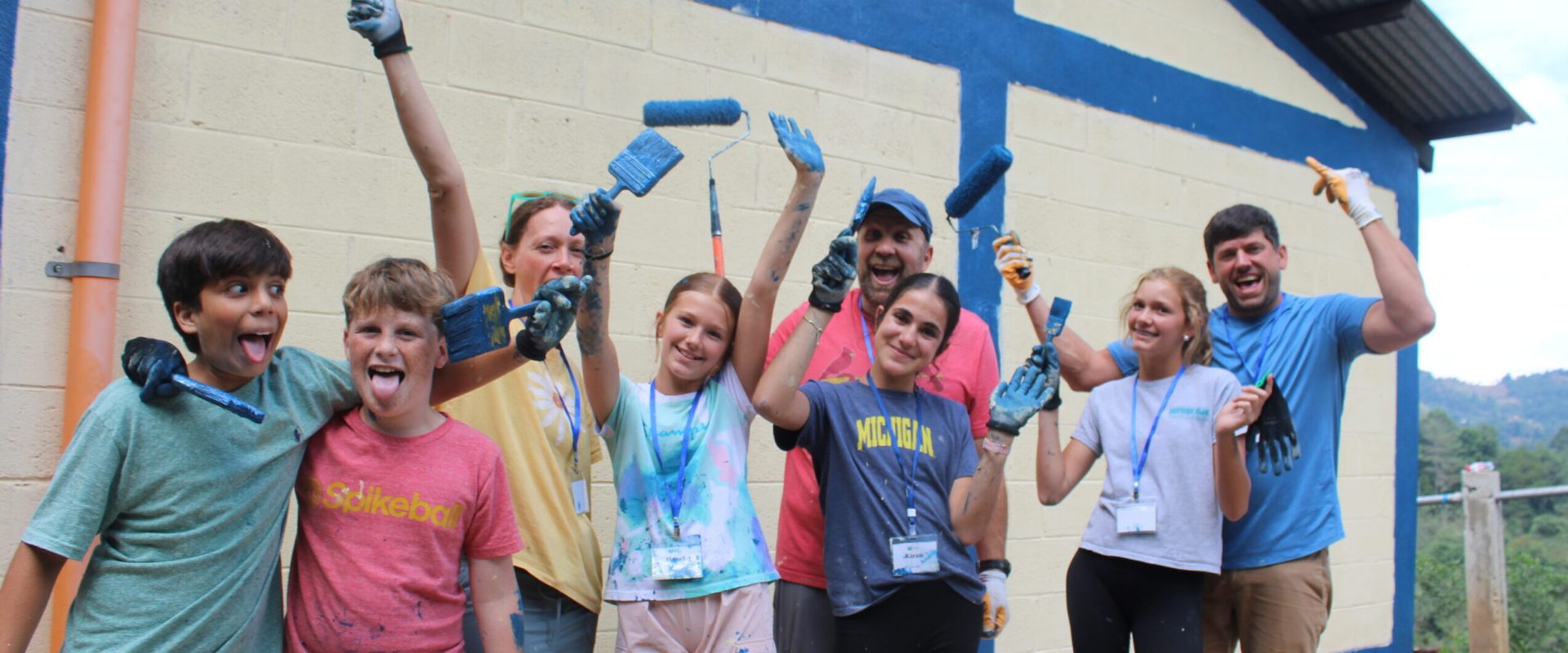
Before they ever picked up a paintbrush in Guatemala, five students from Charleston had already begun building something together.
They washed cars, sold lemonade and baked goods, organized a fundraiser at a local jewelry store, collected gently used school supplies, and appeared on their school news to encourage classmates to contribute. Together, they raised approximately $4,500 to support their project.
The students were entering seventh and ninth grades. None had organized an effort quite like this before. But each found a way to participate, drawing on their own interests, friendships, schools, and communities.
The trip itself began with one family and an idea.
Dr. Pooja Elias had been traveling to Guatemala as part of a team providing specialized medical care. Her children knew about her work, and Pooja and her husband, Jon, had long hoped to include them in an international service experience when they were old enough.
When another medical assignment brought Pooja back to Guatemala, the timing felt right, and the family began exploring how the children might come along.
They could have assisted in small ways at the hospital. But Pooja wanted them to have an experience they could understand and make their own.
“It’s not like they think about an endoscopy and access to that all the time,” she explained. “But they do think about school and access to books.”
Through a mutual friend, Pooja connected with Kate Curran, Founder of School the World. An idea began to take shape: while Pooja completed her medical assignment, Jon and their daughter, Kiran, and son, Ian could spend several days helping refresh classrooms at a rural school.
Soon, the invitation expanded. They asked friends, Kate and Adam Young and their two daughters, Frannie and Hazel, to join them, and their son Ian invited his friend, William Ruder, who had never traveled outside the United States. What began as one family’s plan became a shared experience for three families and their children.
For Pooja and Jon, inviting friends was intentional. They wanted service to feel meaningful, but they also wanted it to feel social and engaging. “Volunteerism is fun when you do it with friends,” Pooja said.
The students’ involvement began long before they arrived in Guatemala.
Kiran helped organize two fundraisers at Kendra Scott, telling friends about the events, handing out cards to shoppers, and explaining where the money would go. She also sold 50/50 raffle tickets at her mom’s global health fundraiser.
Frannie and Hazel held a lemonade stand with baked goods, asking for donations and sharing the purpose behind their efforts.
Ian and William organized car washes. They also approached their school principal, spoke about the project on their school news, and placed collection boxes at school for gently used supplies at the end of the school year. Supplies that were collected were delivered to students in Guatemala.
The students hadn’t started with a goal of raising $4,500. They started with a smaller goal to raise the money to buy paint to freshen up the school, but as soon as they reached that milestone, they signed up for another. The students looked at the opportunities available to them and were energized to ask what they could do.
And with their own savings, they shopped for toys, books, soccer balls and supplies to bring to the classroom.
Before traveling to another country or meeting the students who would use the classrooms, they discovered that contributing could look different for each of them. It could mean speaking in front of classmates, approaching shoppers, making lemonade and baked goods, washing cars, or asking teachers to donate supplies left at the end of the school year.
Their work gave them a sense of ownership over what came next. As Jon recalled, “The work that they started to put in here continued to the work that they did there.”
In Guatemala, the group spent three days painting classrooms. The work was tangible, tiring, and sometimes more difficult than expected. Painting concrete blocks required patience. The students climbed ladders, moved supplies, and worked carefully to cover the walls.
They could also see how much the refreshed classrooms meant to the children watching the work take shape. “When we were working, we knew that this was going to a good cause and that there was meaning to the work,” Frannie reflected. “Every time we were painting, they seemed really excited.”
But the most memorable moments did not happen only while they were working.
The visiting students played soccer, football, jump-rope games, and Spikeball with the Guatemalan students. They noticed familiar rhythms in the school day: classes, lunch, recess, friendships, and the universal desire to play.
Those points of connection mattered. The students encountered a community with different resources and daily routines, but they also met young people whose humor, friendships, energy, and excitement felt familiar.
The relationships helped them see the community as more than a place they had come to help. It was a place where they could learn, play, work, and belong alongside others.
A visit to a student’s home gave the group a deeper understanding of life beyond the classroom. They saw a family cook outdoors, wash clothing by hand, care for animals, and reuse water carefully. William was struck by the family’s resourcefulness. “They had a little, but they made do with what was there,” he said.
Ian recalled noticing how carefully the family used what they had. “They were using and reusing water,” he said. “It made me more conscious about what I’m using and how much I’m using.”
Hazel was struck by how little the group used their devices during the trip. “We weren’t on our phones or iPads,” she said. “You’re actually in the real world.” Being away from their usual routines helped them pay closer attention to the people and places around them.
The visit also prompted Kiran to think about the tendency to overlook what she already has. “I feel like we take so much for granted because we always want more and more and more,” she reflected.
These were not sweeping declarations that everything had changed. The students instead acknowledged smaller shifts in awareness: turning off running water, wasting less food, helping more at home, and recognizing that many conveniences they rarely considered are not available to everyone.
Pooja and Jon never expected every lesson to become clear to the children immediately.
Jon noted that adults sometimes imagine an international service experience will produce a single, dramatic revelation. Young people may absorb it differently. Some insights surface during the trip. Others emerge weeks, months, or even years later.
For their family, one of the greatest benefits is having a shared experience they can continue discussing. “It’s not just there and done,” Jon said. “It’s something that we can always reference.”
That continuing conversation is one of the most powerful ways parents can shape how young people understand themselves and the world. Pooja, Jon, Kate and Adam, modeled a commitment to service. They opened a door, worked beside the students, asked questions, and gave them time to form their own conclusions.
In doing so, they helped the young people begin exploring questions that become increasingly important during adolescence: What do I care about? Where can I contribute? What difference am I capable of making?
The students did not all answer those questions in the same way. That was precisely the point.
They brought different personalities, interests, and skills to the experience. Together, they raised funds, collected supplies, painted classrooms, formed friendships, and returned home with new things to notice.
Students ready to experience service learning firsthand can explore School the World’s 2027 trip calendar.
Travel is not the only way to become involved. Students can also start a School the World club or chapter, raise awareness, organize fundraisers, and invite friends to contribute their own interests and talents. Like the students behind Painting Futures, they can begin with a simple question:
What can we do with what we already have?