
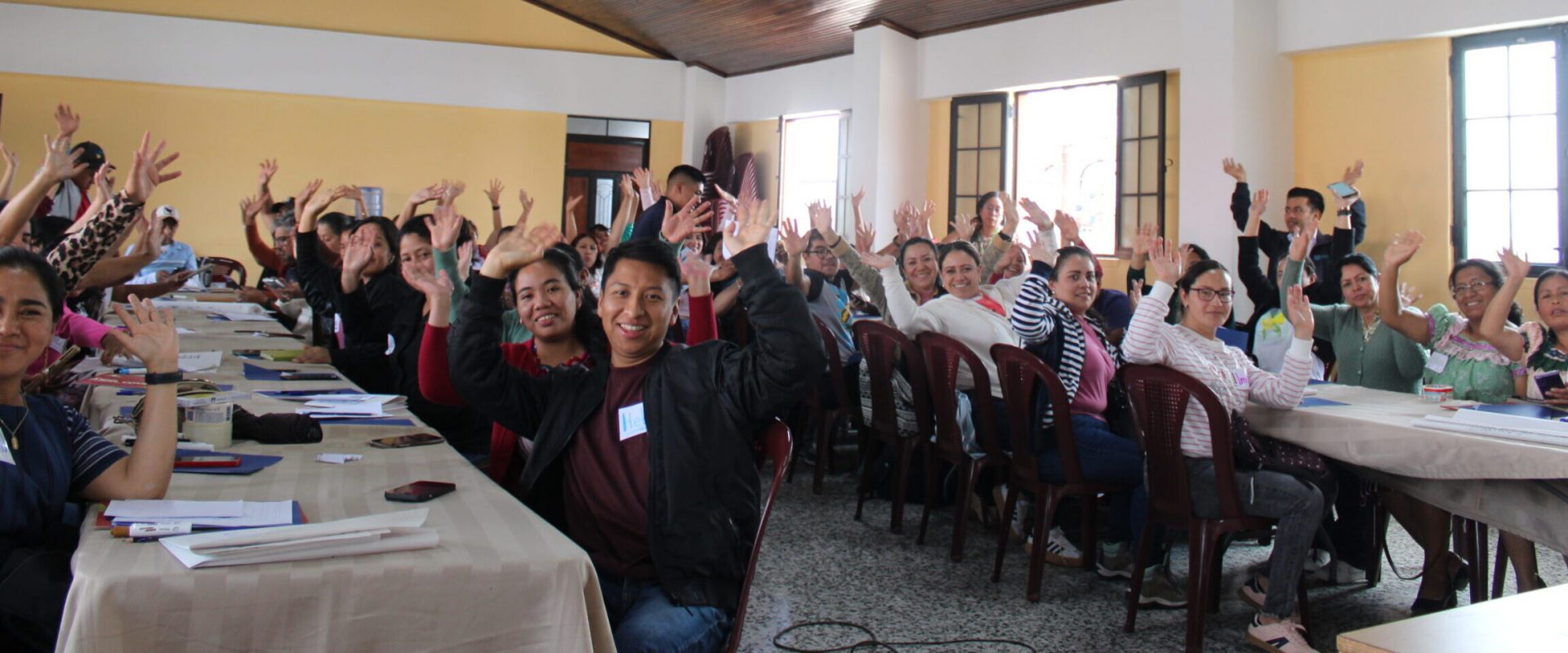
Every year, School the World partners with the communities where we’ve built schools to provide teacher training aimed at raising instructional quality and supporting level-appropriate learning for every student. Through two or three targeted sessions annually, the program brings pre-primary and primary school teachers together for group workshops that cover Teaching at the Right Level (TaRL) instructional methodologies, social-emotional learningm and classroom management strategies, helping teachers build more inclusive and effective classrooms. To date, School the World has trained over 8,400 teachers throughout Central America.
This year’s sessions in Guatemala brought together two groups of educators who work with School the World’s students: full-time classroom teachers and the tutors who staff our Accelerated Learning Recovery Program.
In the post-training survey, teachers and tutors consistently pointed to relationships and trust as central to their work with students. One participant summarized it this way in their written response:
“Tener buena relación con los estudiantes, escuchar antes y utilizar los procesos para dar instrucciones claras.” (Have a good relationship with students, listen first, and use the process to give clear instructions.)
Flory Lobos, a preschool teacher in Chatián, San Antonio Ilotenango, wrote about what happens when that trust isn’t there:
“If we let them down, they won’t want to talk to us anymore and will become afraid of us… The power of relationships is crucial; as teachers, we must know how to foster them through good communication and an atmosphere of trust.”
Angélica Chicaj, a tutor in Xetinamit, Santa Cruz del Quiché, described the same idea from her own work with students:
“No two children are alike, and just like us, they have feelings. We need to listen to them so they learn to trust us!”
Each year, School the World delivers books for classroom libraries to the communities we work in, and this year’s training included a focus on using them: how to build daily reading time into the classroom, and how to lend books so students can read at home as well. Francisco Pixcar, a 5th-grade teacher in Tululché III, Chiché, connected reading directly to student communication:
“Reading in Spanish is also important for children because it expands and enriches their vocabulary; without understanding words, communication cannot be effective.”
This year’s sessions pointed to an opportunity to further help teachers make even broader use of the books already in their classrooms and encourage more reading at home.
The training also covered the role of play in keeping students engaged. This is especially relevant for our tutors. School the World’s tutoring program runs in communities, as a two-year intervention designed to help students finish primary school with functional numeracy and literacy skills. Every student in a participating community is enrolled and grouped by ability level, and the program is staffed by tutors hired specifically for the program..
Angélica described how she uses play directly in her tutoring sessions:
“Being a tutor isn’t just about standing there talking while the children sit and listen. No! Being a tutor means playing with them; through play, we see the learning we aim for.”
Perla San José, a tutor in Ximbaxuc II, gave a concrete example:
“Through games like the ball toss and ‘Hot Potato,’ we encourage the children to look for books and then read the pages I assign them. They enjoy the games and learn while playing!”
Supporting teachers and tutors in the classroom with training that motivates them, gives them new ideas, and provides them with resources to use with students is a core part of how School the World works. It’s one piece of a broader commitment in every community we serve, alongside building schools, supporting parents, delivering books, and, in communities, funding tutoring, all aimed at making sure students get an education that helps them succeed in school and beyond.
Join our newsletter and get the latest updates
By signing up, you agree to receive emails from School the World, Inc..