
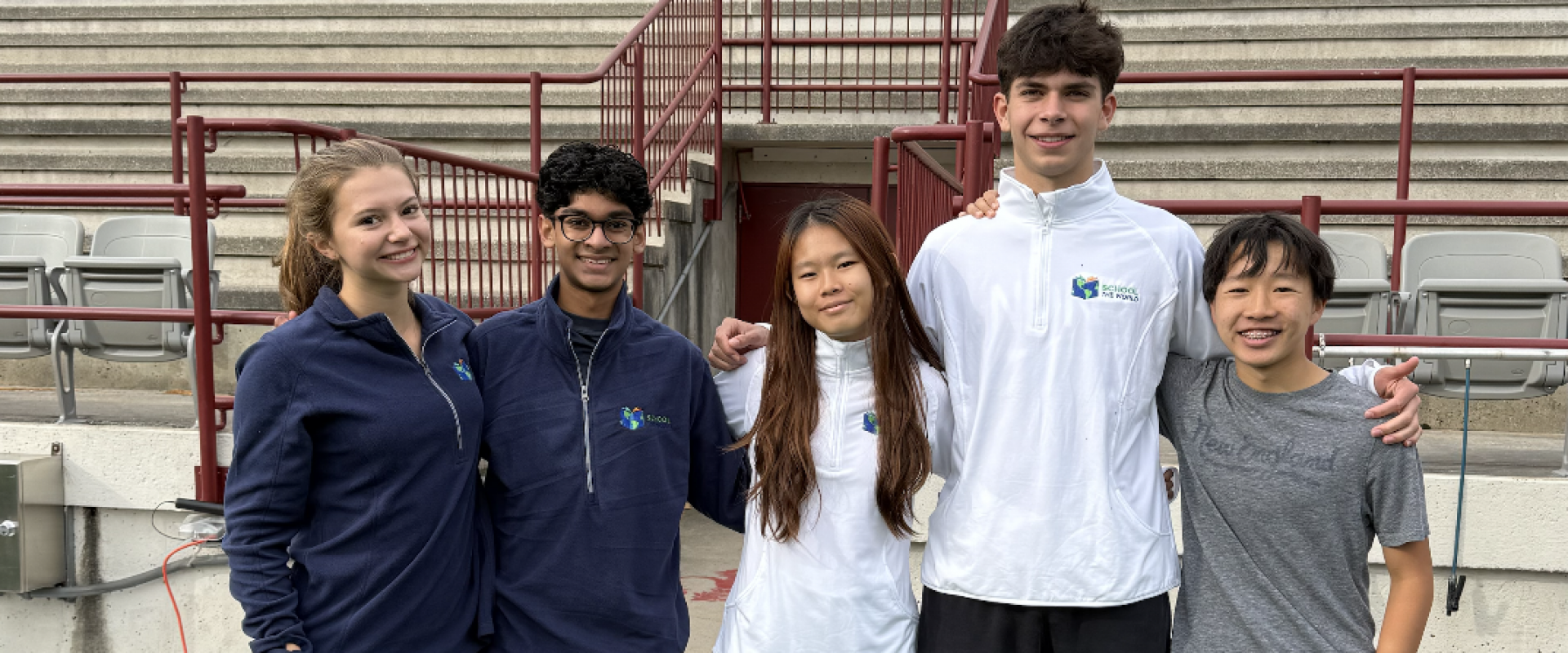
When the student leaders of Red Runners at Phillips Exeter Academy decided to organize a 5K fundraiser for School the World, they set what seemed like an ambitious goal: raise $1,000 to support education in underserved communities.
They ended up raising $3,565, with approximately 50 runners participating.
But getting there wasn’t as simple as announcing a race and watching the registrations roll in.
At first, their faculty advisors weren’t convinced the event was feasible. Organizing a community race seemed like a lot for four students to take on, particularly with limited planning time and all their regular school commitments.
So the students went back and developed a more concrete plan.
“We came to them with a very concrete idea of what we were doing,” explained Annika Nystadt, one of the club’s four co-heads. “We said, here’s what we’re going to need, these are the materials, it’s going to be on this date, and this is how we’re going to do everything.”
That preparation changed the conversation. The event was approved, and the students got to work.
Their experience offers a useful roadmap for anyone thinking about organizing a fundraiser in their own school, workplace, club, or community.
Red Runners is a student-led club that meets on Sundays to run together and engage with the community. Annika and her fellow co-heads, Jocelyn Wen, Sarek Ranadive, and Marcus Kiehl, wanted to turn their shared interest in running into something that could benefit others.
Their first important decision was to scale the event to something they could realistically manage.
Rather than attempting a large town-wide race, they focused primarily on fellow students and a course on school grounds.
They created a detailed materials list, identified what support they would need, established a date, and worked with the school’s student service organization to secure approval and resources.
They also developed a budget with different levels of spending, distinguishing what was essential from what would simply be nice to have.
Phillips Exeter Academy provided valuable support, including access to facilities and funding for supplies and refreshments. But Annika credits the students’ preparation and follow-through with making that support possible.
Her advice to other organizers? Before asking for help, be ready to explain exactly what you’re planning, what you need, and what you’ll take responsibility for yourself.
Once the race was approved, the next challenge was getting people to show up.
The students used posters with QR codes, a schoolwide email, and an announcement at assembly. But their most memorable promotional tactic involved approximately 1,000 clothespins.
Red Runners had developed a tradition of attaching clothespins with club information to students’ clothing during school activities. For the 5K, they wrote the race name, date, and time on the pins and distributed them across campus.
Soon, people were talking about the race. Some even asked Annika for more clothespins.
The students also promised snacks, encouraged volunteers to participate, and offered School the World merchandise as prizes.
But Annika says their most effective recruiting strategy was also the simplest: talking to people.
“I think the most impactful part was that we were just constantly talking about it with our friends,” she said.
The night before the event, those conversations brought in roughly 10 additional registrations.
The takeaway is simple: Don’t rely on a single announcement or social media post. Give people a reason to notice your event, then invite them personally.
The Red Runners initially considered charging $20 to participate, but realized that price might discourage students. They lowered the registration fee to $15.
Working with School the World, they created an online fundraising page through Givebutter where supporters could purchase a race ticket, make an additional donation, or simply contribute without running.
This turned out to be an important distinction. Their fundraising wasn’t limited to the approximately 50 people who ran the race.
The students shared their fundraising link on Instagram, reached out to alumni, and asked friends and family to contribute. Annika, whose family is Guatemalan, sent the appeal to a large family group chat. Her father also shared it on LinkedIn.
Other club leaders reached into their own networks.
They even encouraged volunteers to compete in raising funds, creating another opportunity for people to get involved.
The result was a fundraising effort that extended well beyond the starting line.
A community fundraiser doesn’t have to depend entirely on participation fees. Create opportunities for people to support the cause even if they can’t attend.
Planning a race was new territory for the student leaders. They had experience participating in school activities, but not organizing a fundraiser of this kind.
Annika says having a team that could depend on one another made a tremendous difference.
When one student was overwhelmed with schoolwork or had a test to prepare for, another could step in.
They also made responsibilities clear. Ahead of the race, the team created course maps, marked the route using washable paint, prepared race bibs and timing sheets, and assigned volunteers to specific positions along the course.
The day before the event, the co-heads were still preparing materials after competing in their own cross-country meet.
On race morning, they arrived at 8 a.m. to check the route and finish setting up. Volunteers had been asked to arrive at 9:30, and each student leader had a designated responsibility, from registration to volunteer coordination and course management.
They kept expenses down by using existing school materials and making their own signs.
For Annika, two ingredients made the event possible: “Organization and a good team.”
Not every organizer has access to a boarding school’s grounds, supplies, and institutional support. But the underlying approach applies anywhere: start small, divide responsibilities, recruit volunteers, use what you already have, and plan far enough ahead that everyone knows what to do.
For Annika, supporting School the World was personal.
Her family is from Guatemala, one of the countries where School the World works. She had learned about the organization through a cousin who had previously fundraised for it.
She also understood firsthand how resources could change a school’s opportunities. Several years ago, Annika and her sister worked with their community in Connecticut to bring Chromebooks and a computer science program to a small school in Flores, Guatemala, where their mother had attended school.
That connection helped make the cause something she could talk about naturally with friends, family, and potential supporters.
And now, the money the Red Runners raised will make a difference for students in Guatemala.
$3,000 will fund a three-year middle school scholarship for a girl in Guatemala, helping her continue her education through seventh, eighth, and ninth grades. For many girls in the rural communities where School the World works, education can end after sixth grade because their families cannot afford the costs of continuing. Read more about what it takes for girls to stay in school beyond sixth grade.
The remaining $565 will help create classroom bookshelves in a School the World partner school. Each year, School the World and parents invest together in new books for their children’s classrooms. The bookshelves will make those growing collections more visible and accessible, encouraging students to pick up a book and read whenever they have the opportunity. Watch how a classroom reading space can bring books to life for students.
For a group of student runners, that means helping another young person continue her education while also making books more accessible to younger children.
The students hope the 5K might become an annual Red Runners tradition, with younger club members eventually taking the lead.
And that may be one of the most valuable lessons of all: a successful fundraiser doesn’t have to end when the event is over. It can become something others build upon.
You don’t need to organize a 5K or raise thousands of dollars to make a difference.
A school club could host a walkathon. A running group could dedicate a weekend run to a cause. Coworkers could organize a friendly fitness challenge. A neighborhood group could hold a community walk.
The formula that worked for Red Runners is one anyone can adapt:
The Red Runners set out to raise $1,000. They finished with more than three and a half times that amount, a successful community event, and a model they hope to repeat.
What could your school, club, workplace, or community do together?
If you have an idea for a fundraiser benefiting School the World, we’d love to help you get started.
Join our newsletter and get the latest updates
By signing up, you agree to receive emails from School the World, Inc..