
“Look up. Look up.”
Bruno Vergara was still looking at his phone as the car pulled into San Rafael, Honduras. His father, Oscar Vergara, had already seen what was waiting outside: students holding posters and balloons, ready to welcome Bruno back.
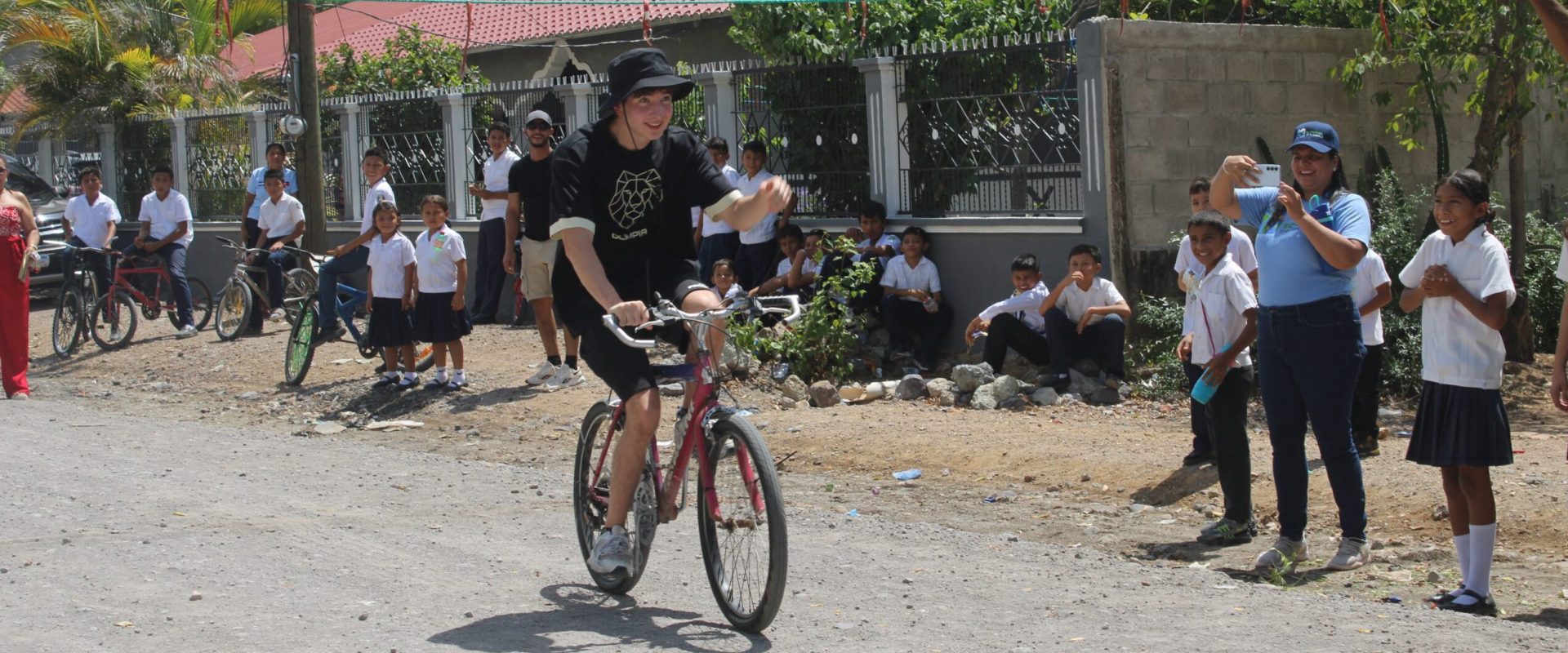
Then one child began running toward the car. Bruno recognized him immediately. He stepped out, lifted the boy onto his back, and within seconds was surrounded by children eager to hug him.
For Bruno, it was a reunion. For his father, it was the first chance to see what Bruno’s School the World experience had meant, not only to his son, but to an entire community.
Bruno first traveled to San Rafael as a World Changer in July 2025. During that week, he worked alongside community members to help build a school and playground. His Honduran heritage and ability to speak Spanish also helped him form close relationships with the children and families he met.
In a reflection written after that first trip, Bruno described it as a journey back to his mother’s homeland and the best experience of his life.
But when he first arrived home and his parents asked how it had gone, his answer was typical of many teenagers.
“It was good. It was great.”
It was not that the trip had meant little to him. It had meant so much that it was difficult to capture in a few words. He told his parents about San Rafael, the children he had met, and how welcomed he had felt. But some experiences are hard to understand when you were not there to witness them.
Over the following year, Bruno continued talking about the community. What began as a passing conversation about returning eventually became part of a family trip to Honduras, where Bruno’s mother is from and where members of his family still live.
This time, Oscar would come with him to San Rafael.
As Bruno walked toward the school, more familiar faces appeared. Children, teachers, and families greeted him by name and recalled moments they had shared during his first visit.
“The farther I kept walking, the more people I recognized,” Bruno said.
Music was playing as the school director welcomed Bruno and Oscar as special guests. Bruno was invited to speak in front of the school, an unexpected test of both his emotions and his Spanish.
“I was really appreciative that they wanted me back,” he said. “They had done something so special. I felt really welcomed.”
The class president and school director then presented him with a plaque of gratitude. When Bruno later showed it to his family, they were stunned.
The welcome revealed something Bruno could not have known when he boarded the plane home the first time: the community remembered him just as clearly as he remembered them.
The rest of the day unfolded with soccer, a traditional Honduran lunch, piñatas, and cintas, a school tradition in which children ride bicycles beneath a suspended ring and try to pass a pencil or small stick through it. Bruno’s mother remembered playing a version of the game during her own childhood, although the children rode horses instead of bicycles.
For Bruno, the celebration reflected something he values deeply about Honduras: the warmth with which people welcome others and hold onto the relationships they form.
“In this community, everybody knows one another,” he said. “They treat everyone like a sibling or cousin.”
That welcome extended to Oscar, too. Although he is Ecuadorian, he attended college in Honduras and still carries traces of a Honduran accent. The children greeted him with hugs and jokingly named him the “Ecuadorian catracho,” adapting the affectionate term Hondurans use for themselves.
He had arrived as Bruno’s father. By the end of the day, the community had made room for him, too.
Parents entrust School the World with their children for a week that can challenge them, stretch them, and help them discover what they are capable of contributing. But parents rarely get to witness that experience firsthand. They hear the stories afterward, look at the photographs, and try to understand what changed.
Oscar had a different opportunity. He stood beside Bruno as children ran to greet him. He heard teachers, community members, and School the World staff talk about the impression his son had made. He watched Bruno move comfortably through the school, reconnecting with people who were genuinely happy to see him.
Bruno describes his father as someone who is direct and sparing with compliments. That made it especially meaningful to hear Oscar speaking proudly about him during the visit.
“It was surprising to hear my dad say, ‘It’s amazing what Bruno did,’” Bruno recalled. “It was my first time hearing his honest, true opinion. It was a moment I’m proud of.”
On the drive back to Tegucigalpa, Oscar was unusually reflective.
“There are only a few rare moments when I see my dad shocked,” Bruno said. “He was like, ‘You were right. I’m so glad we did this. This is something to cherish.’”
Oscar had listened to Bruno’s stories before. Now he had seen the relationships behind them.
Before leaving, Bruno and Oscar asked the school director whether the celebration had taken too much time away from the students’ regular school day. She assured them that the gathering was a special field day and that moments like these can help motivate children to keep coming to school.
“It inspires them,” Bruno remembers her saying. “It really gets them motivated.”
For students in San Rafael, welcoming someone back carries a powerful message. It tells them that their community was not simply one stop on someone else’s journey. The time spent together mattered, and the relationships were real.
That is one reason returning to a former partner community can be such a meaningful part of another School the World trip. When World Changers travel with us again, we make time whenever possible for them to visit the community where their experience began.
These reunions can be emotional. Returning World Changers discover that the connection did not end when they boarded the vans and planes that carried them home. Their names may still be remembered. The children they met may be waiting to welcome them back.
When Bruno left San Rafael after his first trip, he did not know whether he would ever see the children again. This time, the goodbye felt different.
“It was like saying goodbye to a family member after going on vacation for a while,” he said.
The experience continues to shape how Bruno imagines his future. Now a student at UMass Boston, he is exploring engineering and thinking about how he might someday contribute to infrastructure in communities across Central America.
His relationship with San Rafael began with one week of working alongside the community. A year later, the posters, hugs, stories, and plaque waiting for him showed that something lasting had also been built.
Bruno had wondered whether the community would remember him.
They did.
Now the question is not whether he will be welcomed back. It is when he will return