
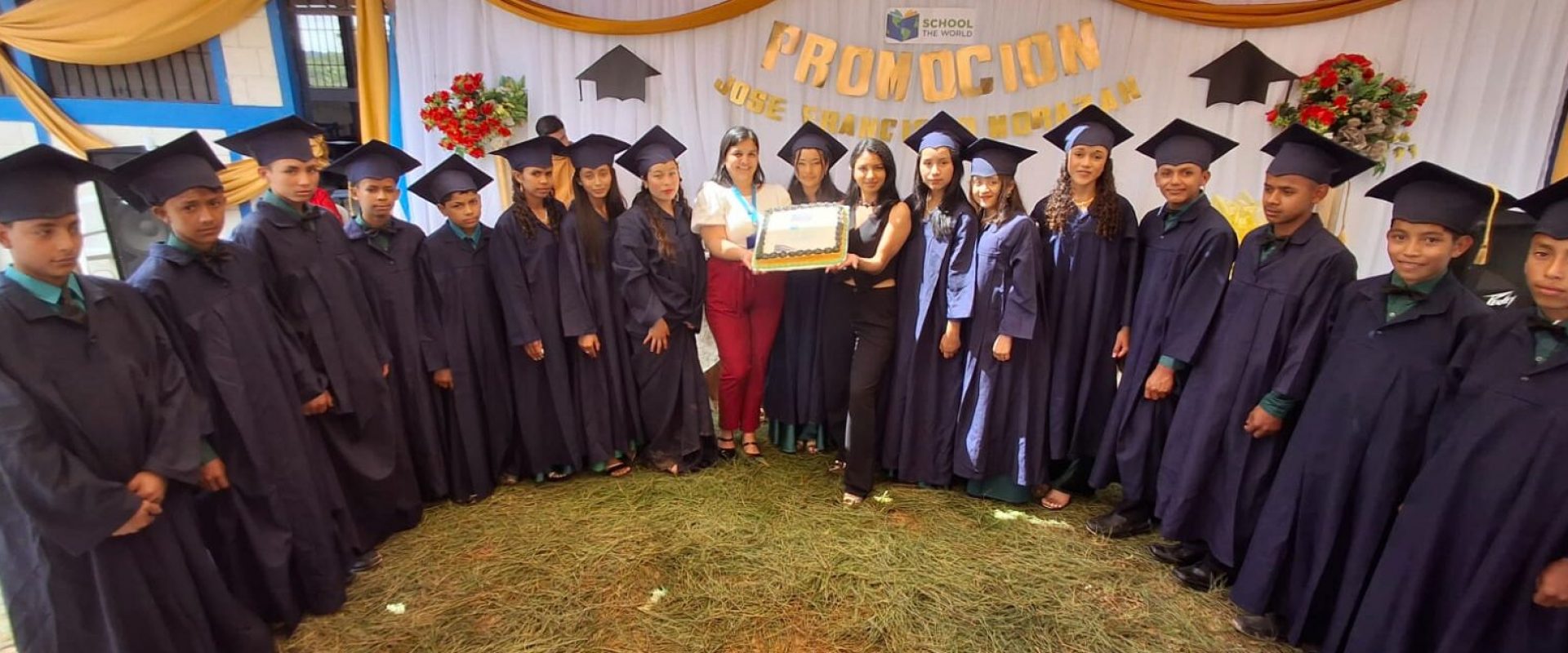
For a student in rural Guatemala or Honduras, finishing sixth grade can mark a touring point in their lives.
School the World’s Scholarship Program was created to help students make the transition from primary school into the three years of lower secondary school that follow. We provide financial support and ongoing coaching through grades 7–9, with approximately 70% of scholarships intentionally directed toward girls.
But awarding a scholarship is only the beginning.
Over the past six years, we have been building a much clearer picture of what happens afterward: Who stays? Who graduates? When are students most likely to leave? And where might additional support make a difference?
Our most recent program review looked at more than 1,390 scholarship recipients in Guatemala and Honduras. The data is encouraging. It also gives us important questions to continue to investigate.
Education has implications far beyond the classroom. More years of schooling are associated with greater earning potential, better health and well-being, and greater agency over decisions that shape a person’s life. For girls in particular, secondary education is also closely connected with later marriage and childbearing and better health and economic outcomes for themselves and their children.
On paper, students in both Guatemala and Honduras are expected to continue beyond primary school. Guatemala includes lower secondary education, or básico, within compulsory education, while Honduras defines nine years of basic education as compulsory.
In practice, the transition is much harder.
In the rural communities where School the World works, many students are growing up in families where their parents may not have had the opportunity to continue beyond primary school themselves. Continuing after sixth grade can mean new school and transportation expenses, traveling farther from home, and giving up time that could otherwise be spent working and contributing to household income.
In the communities we serve, young people take on more economic and family responsibilities, and marriage and parenthood can come early. According to UNICEF, 30% of young women ages 20–24 in Guatemala and 34% in Honduras were married or in a union before age 18.
Education and early marriage are closely connected. Leaving school can make early marriage more likely, while remaining in school can expand a young woman’s options and help delay marriage and childbearing. That is the problem the Scholarship Program is designed to address.
A scholarship cannot remove every barrier a young person faces. But it can make continuing school a viable choice at precisely the transition when leaving education can otherwise become much easier, or even expected.
The question we want our data to answer is what happens once that opportunity is there.
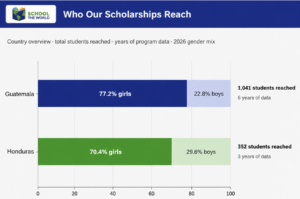
The Guatemala Scholarship Program is the more established of the two, with 1,041 students participating since 2020. Honduras launched later, in 2023, and has served 352 students to date.
In both countries, the program intentionally prioritizes girls. In Guatemala, girls have represented at least 70% of active scholarship recipients every year since 2021, reaching 77% in 2026. As the newer Honduras program has grown, its gender mix has moved toward the same target, with girls representing about 70% of active scholars in 2026.
That focus matters because financial barriers are only one reason young people stop studying. Our data helps us ask the broader question: What happens across hundreds of students when the opportunity to continue becomes more attainable?
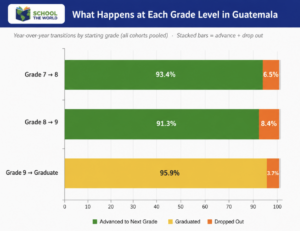
One of the clearest patterns in the Guatemala data is that academic progression itself does not appear to be the primary obstacle.
Among students who remain in the program:
Dropout at each individual grade transition ranges from about 4% to 8%.
In other words, once students are in school and engaged, most are academically able to move forward.
The bigger challenge is keeping them there across the full three-year journey. Rather than focusing only on whether students can pass, we need to understand the circumstances that cause some students not to return for the next year.
Because a scholarship supports a three-year middle school journey, completed cohorts give us our clearest measure of longer-term outcomes.
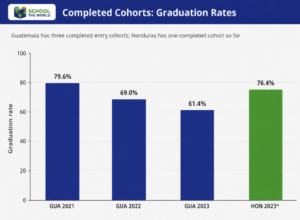
In Guatemala, approximately 80% of the students who entered the program in 2021 graduated. For the 2022 cohort, that figure was approximately 69%. For students who entered in 2023, it was approximately 61%.
If most students who remain enrolled are progressing successfully, then the challenge may be less about whether students can do the academic work and more about what happens between school years and across the full three-year transition through middle school.
Are financial pressures changing? Do particular communities face different barriers? Are there moments when students need more contact or support? Are changes to the program improving persistence among newer cohorts?
Some of those questions can already be explored through the data. Others require us to learn more directly from students and families.
Honduras provides an interesting early comparison.
Of the first 55 students to enter the program in 2023, 42, or 76%, completed middle school. Across the program to date, measured retention after the first and second years has also been strong.
Those are encouraging results.
But Honduras has only had one cohort with enough time to complete the full three-year program. The sample sizes are smaller, and the program’s historical data collection has not always allowed us to distinguish student departures with the same precision as the longer-running Guatemala program.
For that reason, we see Honduras as an early signal, not yet a benchmark against which Guatemala should be judged.
As more cohorts progress through the program and our data collection becomes more consistent, we will be better able to determine whether these patterns hold.
Our review also looked at an important program-design question: does the amount of financial support students receive appear to affect persistence?
School the World offers both full and partial scholarships to girls. Among female students, those receiving full scholarships have shown higher retention than those receiving partial scholarships. After three years, estimated retention was approximately 82% for students receiving full scholarships compared with 76% for those receiving partial scholarships.
Among female scholarship recipients in Guatemala, three-year retention was higher for students receiving full scholarships than for those receiving partial scholarships: 81.5% compared with 75.5%.
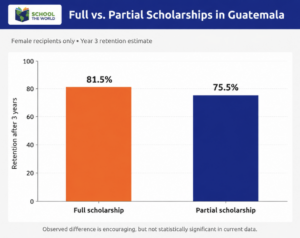
That is encouraging, but it is not yet proof that receiving a full scholarship causes the better outcome. Students receiving different types of scholarships may differ in other ways, and our statistical analysis did not find the difference strong enough to establish scholarship type itself as the cause.
If more comprehensive financial support is associated with stronger persistence, we want to understand why. Does it ease pressure on students to earn income? Does it change how feasible families believe another three years of education will be? Or are there differences among the students who receive the two scholarship types?
Those answers can help us determine where additional resources have the greatest impact.
For years, we have defined scholarship success in two stages:
First, does a student finish middle school?
Then, does that student continue into high school?
Our data is becoming much stronger on the first question. We still need to improve on the second. Both our Guatemala and Honduras program reviews identified consistent post-program tracking as an important gap.
We know individual stories.
Shelzy, a former scholarship recipient from Guatemala, once saw continuing her education as something that might simply not be possible. She ultimately continued through secondary school and is now studying law at a university, with hopes of serving people in her community in K’iche’.
Former scholars Evelin and Ángel both continued their education after their School the World scholarships ended.
Those stories show us what is possible. They don’t tell us how often it happens across the program as a whole.
Building more consistent post-scholarship tracking is therefore one of our next measurement priorities. We want to understand not just whether students complete ninth grade, but what doors that transition opens afterward.
It would be easy to tell the scholarship story using only the strongest numbers.
More than 1,390 students reached. A program intentionally prioritizing girls. High rates of academic progression among students who remain enrolled. Hundreds of middle school graduates.
Those things matter, and we are proud of them. But collecting data has another purpose. It helps us see the questions hiding inside the averages.
Why have graduation rates changed between cohorts? What happens during the transition from one school year to the next? Do students receiving full scholarships face fewer barriers to staying enrolled? Why do outcomes differ in some communities? And what happens after students leave our program?
Six years of data doesn’t give us every answer. It gives us something equally valuable: a clearer understanding of what is working, where students are still being lost, and what we need to learn next.