
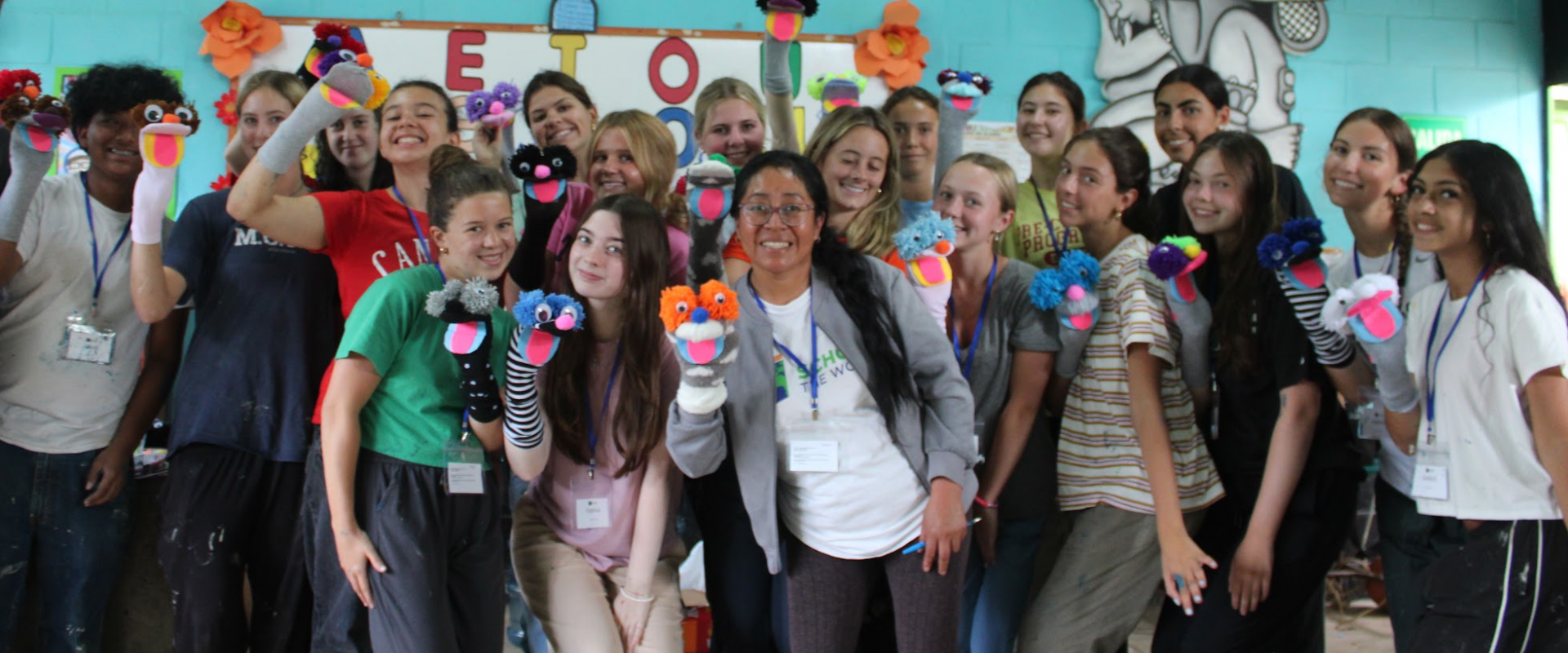
When Josefina Lux visits the communities School the World serves, she does more than explain a program or encourage students to stay in school. She tells them her own story.
It is not always easy for her to revisit the doubts, hardships, and expectations she faced growing up in Guatemala. But Josefina knows that when young people hear from someone who has confronted many of the same obstacles they face, her story can offer something powerful: a path forward.
She can tell a girl whose family does not prioritize her education, “I understand.”
She can tell a student balancing school with work and responsibilities at home, “I have been there.”
And she can tell a family that cannot see how they will afford another year of school, “There may still be a way.”
Josefina does not simply ask students to imagine what is possible. She shows them.
Josefina was the oldest of eight children. Her father believed her brothers needed an education, but that investing in his daughters’ schooling would be a waste.
“He thought I would eventually marry, so studying would be a waste for me,” she recalled.
Josefina was expected to stop studying after sixth grade. She was also expected to help at home and contribute to her family, responsibilities familiar to many of the students School the World serves.
But Josefina wanted a different future.
“What comes next for me?” she remembers asking herself. “I wanted to continue studying and also support my parents.”
Without the financial resources to continue, Josefina found her own way. Her mother, a seamstress, had taught her to make traditional K’iche’ blouses. Josefina accepted every sewing job she could, sometimes working late into the night to finish an order. She used what she earned to pay for school.
“Whenever people brought us sewing, I accepted it,” she said. “It did not matter if I had to stay up very late. I completed it, delivered it, and was paid.”
With help from her mother and money she earned herself, Josefina completed middle school and trained to become a preschool teacher. Later, while working as a community health educator, she continued putting her paychecks toward a degree in social work.
Her education did not follow a simple or uninterrupted path. She has had to pause at times, but she has never abandoned it. Today, Josefina is one year away from completing her bachelor’s degree.
Josefina joined the School the World staff as a Change Agent after hearing about an opening during the COVID-19 pandemic. Because she grew up in a community like those the organization serves, she recognizes many of the pressures students face before they have to explain them.
One student in particular reminded her of her own childhood. The boy walked a long distance to school because his family could not afford transportation. He sold tomatoes and other produce at the market to help pay for school expenses, while his mother questioned what continuing his education would accomplish.
Josefina understood both his determination and his mother’s concern.
“I told her, ‘It is an expense now, but one day he will benefit from it. Let him continue. Support him.’”
The student received a scholarship, and his mother began attending scholarship meetings and becoming more involved in his education. He has now completed básico, or middle school.
“I do not care about walking,” he told Josefina. “I am going to continue studying.”
Josefina knows that financial support mattered. But so did having someone recognize his struggle, speak with his family, and reinforce his belief that continuing was worthwhile.
Josefina shares her story during community visits and with students traveling to Guatemala through School the World’s service learning program. Returning to those difficult memories can be painful, but she wants others to understand what she overcame and what became possible because she continued.
Her story helps visiting students better understand the realities young people in rural Guatemala may face. For students from the communities School the World serves, it offers something even more personal: the example of a woman whose life began with many of the same limitations others had imagined for them.
Josefina’s father eventually acknowledged that she had been right to continue her education.
“You were capable,” he told her. “If I had not let you continue, you would have married very young, and I think you would have suffered.”
He apologized for not supporting her. Josefina also watched her example ripple through her own family. Her sister Crissy completed teacher training and university. Her sister Brenda, who married young, returned to school and is now finishing a degree in social work.
“We overcame so much negativity,” Josefina said. “I feel proud of my sisters.”
Today, Josefina uses the credibility of her experience to encourage other students, especially girls, to see more for themselves.
“Girls are not only here to do housework,” she tells them. “We are women, and we are capable.”
Josefina cannot remove every obstacle a student faces. But she can stand before a young person who doubts whether continuing is possible and offer honest encouragement grounded in experience.
She can show them that someone who once stood where they stand kept going.
And sometimes, seeing that path is where hope begins.