
“Me? Study as a child? Not even in my dreams.”
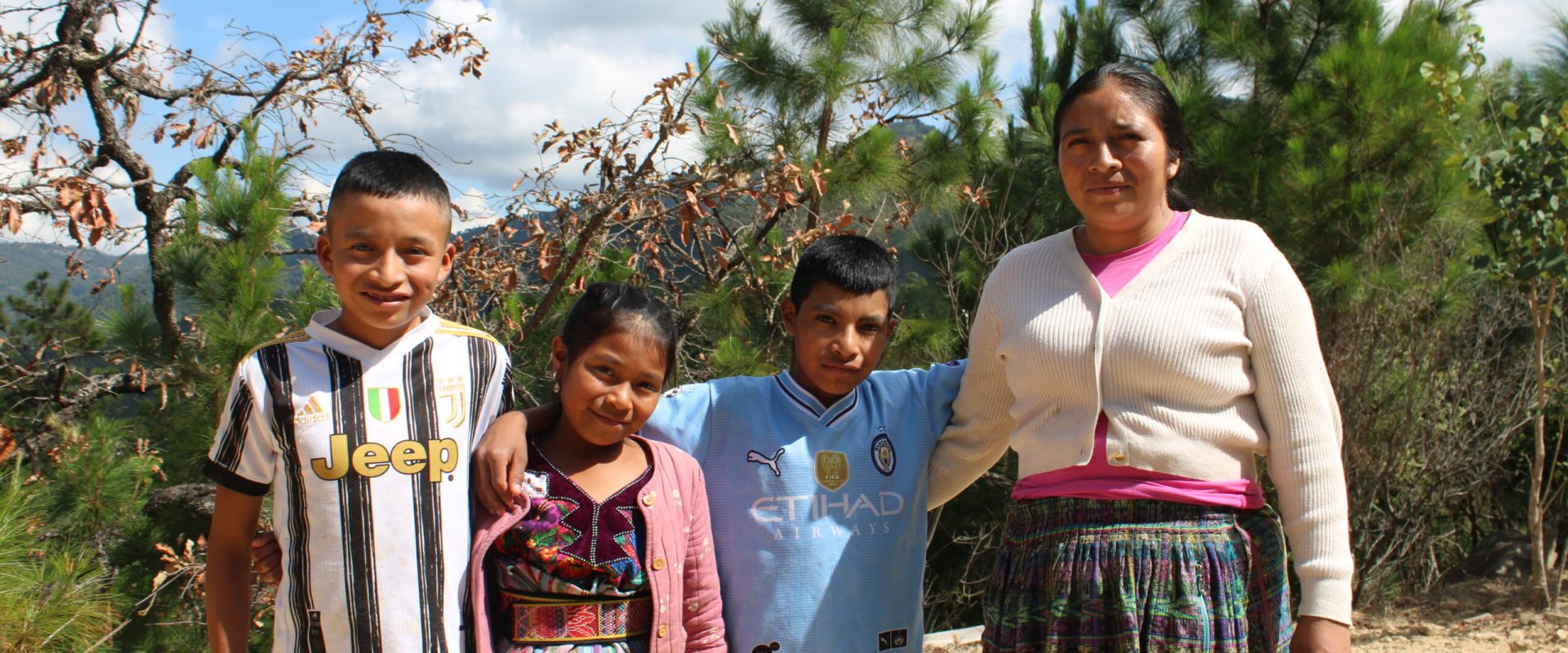
These are the words of Claudia Tojín, a 27-year-old mother and community leader in Quecá, Santa Cruz del Quiché, Guatemala. Her story is one of lost opportunities, but more importantly, it’s a story of transformation—not just of a community, but of hearts and minds about the power of education.
For generations, education in Claudia’s community was almost impossible. Children who wanted to study faced a grueling four-hour round-trip journey to the nearest school. During the rainy season, the situation became even more dangerous—they had to cross a river that would swell and become impassable, forcing children to miss days or weeks of school.
“My parents didn’t believe in education,” Claudia explains. “Since they didn’t go to school, they thought: well, what’s school for?”
Like many parents in her community, Claudia’s parents couldn’t see the value of something they had never experienced themselves. So Claudia spent her childhood doing household chores, caring for siblings, feeding animals, and chopping firewood. At age 12, she began working, tying threads for Q150 (about $19 USD) per month.
At 17, a teacher briefly came to the community and set up classes in a makeshift shed where dust, cold, and rain poured in. It was there that Claudia held a pencil for the first time. “It was very exciting!” she remembers. She learned just enough to sign her name instead of using her fingerprint, but barely enough to read.
“I always have to ask: ‘What does it say there? I can’t read!’ I would have liked to be a professional! To be a teacher and teach the children of my community. I really needed to know how to read and write to defend myself in life!”
In April 2016, School the World arrived in Quecá. We didn’t just build two classrooms and leave—that’s never been our model. We built the foundation, yes, but we understood that physical infrastructure alone doesn’t transform communities. What transforms communities is when parents, teachers, and leaders embrace education as essential to their children’s futures.
“The dream of going to school, I had left behind,” Claudia says. “But I knew that my younger siblings, nieces, nephews, cousins, and children would enjoy the two classrooms built by STW.”
During construction, Claudia walked the hour-and-a-half path to bring food to the workers. No vehicles could reach the community, so all materials had to be carried in by hand. “It was tiring,” she recalls, “but look at my school! I couldn’t study there, but it brings me great joy that the children have a nearby and safe place to study.”
But here’s what makes School the World’s approach different: we knew that building the classrooms was only the beginning.
After construction is complete, School the World commits to five years of intensive parent empowerment and teacher training programs. This is where real transformation happens.
Today, Claudia serves as Treasurer of the Parents’ Board—a leadership position that would have been unimaginable to her just years ago. “I feel good, happy, and important. I like learning to be a leader in my community! I don’t like always being at home; cooking, washing, tending to my cows, sheep, and pigs. Having a position in the community helps me feel better.”
Though she can barely write numbers, Miss Rosita, the school’s teacher and principal, helps her. “She is very good!” Claudia says warmly.
This collaboration between parents and teachers is exactly what our long-term programming cultivates. Miss Rosita herself speaks to the impact: “When they sent me to work at this school, I didn’t care about the distance, because when I arrived and saw the construction of the classrooms and the reading books, what was I going to complaining about?”
The reading books Miss Rosita mentions are part of School the World’s five-year library program—a model designed to build both resources and community ownership. Here’s how it works: each year, the community raises funds for books, and School the World provides matching funds on a decreasing scale. In year one, we multiply their contribution by five. In year two, by four. In year three, by three, and so on. By year five, it’s a one-to-one match.
“The books help my students’ learning tremendously,” Miss Rosita explains. “They can barely speak Spanish, since their native language is K’iche’, and reading helps them enrich their Spanish vocabulary. Reading the books also helps them with grammar and having better writing. The books cover different topics and it’s a way to learn about other realities beyond their community.”
This graduated matching model does something powerful: it teaches parents that they can—and should—continue investing in their school’s improvements long after School the World’s formal program ends. When parents like Claudia work together to raise funds for books, they’re not just building a library. They’re building the habit of collective investment in education, a skill that will serve their community for generations.
Despite traveling an hour to the main road and then walking 40 minutes up steep climbs to reach the school each day, Miss Rosita is committed. “STW has made me feel very happy to teach in this community.”
Perhaps the most powerful impact of School the World’s long-term approach is evident in how the community’s beliefs about education have shifted.
“My parents didn’t believe in education,” Claudia reflects. “Thanks to STW, now my parents do believe that studying is important and the children no longer have to walk two hours, under the sun, the rain, or cross a river. That’s why my parents and uncles now allow the children to come study; otherwise, they would be like me, knowing nothing.”
The journey that once took two hours now takes just 25 minutes. But more importantly, the journey in parents’ hearts—from skepticism to belief—has been even more profound.
Claudia’s five-year-old son, Héctor, will soon start school. “I didn’t study, nor am I a professional; but Héctor will be,” she says with conviction. “I’m going to support him so he doesn’t miss classes, doesn’t fail any grade, or stop studying.”
Her niece Rosa, a bright nine-year-old in third grade, beams when talking about school: “I really like coming to school. I love studying and learning! My favorite class is Natural Sciences. I am happy at school!”
What moves us most about Claudia’s story is that her dream hasn’t died. “Sometimes I dream that maybe someday I’ll study and be a professional. Why not? That dream is still inside me; I haven’t lost it, it hasn’t died.”
When she receives a WhatsApp message and can’t read it—having to use voice messages instead—it frustrates her. “It makes me angry,” she admits. But rather than let that bitterness consume her, she channels it into determination for the next generation.
“I want my niece Rosa to better herself and not leave school. She’s a very intelligent girl and she loves to study! I support her a lot, especially because she’s a girl. I want her to take advantage of the opportunity to go to school and not be like me, whose parents didn’t let me study.”
Claudia’s story illustrates why School the World’s model goes far beyond construction:
We don’t leave when the classroom is built. We stay for five years, working alongside parents, teachers, and community leaders to ensure that education becomes woven into the fabric of community life.
We empower parents to lead. Through parent boards and leadership training, parents like Claudia gain confidence, skills, and a voice in their children’s education.
We train teachers for lasting impact. Miss Rosita uses STW’s reading books to help her students—who speak K’iche’ as their native language—build Spanish vocabulary, improve grammar, and discover worlds beyond their community.
We cultivate belief in education’s value. When parents see the difference education makes, they become its fiercest advocates. They ensure their children attend regularly, complete their studies, and even pursue education beyond primary school.
We create ripple effects. Claudia now supports not just her own son, but her nieces, nephews, and younger siblings. Miss Rosita travels two hours each day because she believes in these children. The transformation spreads.
“What I do know is that the children will no longer suffer what I have suffered from not studying,” Claudia says. “The story of my son, my niece Rosa, and my younger siblings will be different.”
This is the heart of School the World’s mission: to transform communities through education by ensuring that every child has access to quality schooling, that parents understand and embrace education’s value, and that communities own and sustain this change for generations to come.
Claudia closes with words that capture what our work means: “STW, thanks to you, there’s no need to cross a river and walk two hours to study. The children will no longer miss classes because a river won’t let them cross. Thank you for building our school! It’s a blessing; a great gift from God.”
But we know the real gift isn’t just the building—it’s the transformation of belief, the empowerment of parents, the dedication of teachers, and the dreams of children like Rosa who are now free to learn, grow, and become the professionals their communities need.
That’s why we stay. That’s why we commit for five years. That’s why we invest in people, not just infrastructure.
Because education doesn’t transform communities when we build and leave. It transforms communities when we build, stay, empower, train, and believe alongside them.