
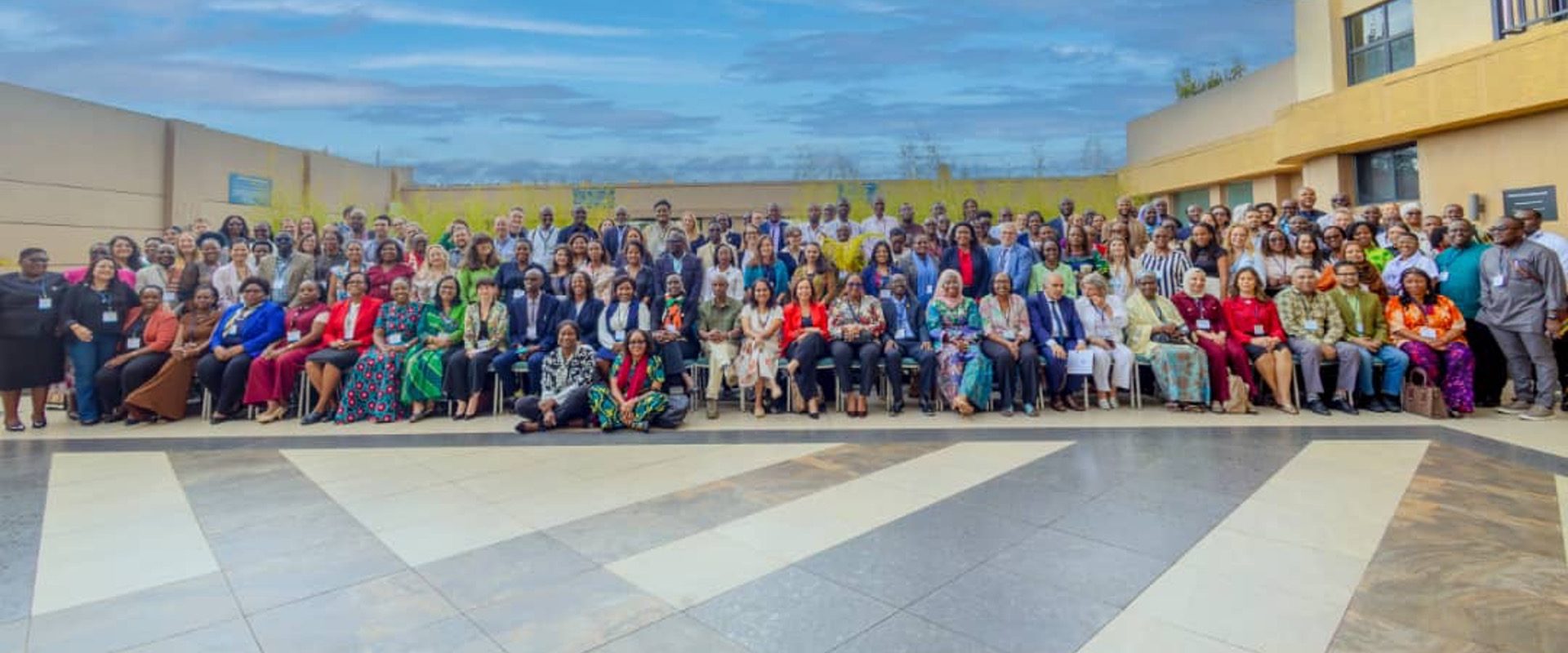
In a room of ministers, global funders, and early childhood experts from around the world, one voice was speaking for rural Guatemala. That voice belonged to Rut Bran.
In early May, School the World’s Early Childhood Regional Program Manager traveled to Kigali, Rwanda to participate in a forum hosted by the Early Childhood Development Action Network (ECDAN), a coalition of governments, universities, NGOs, and foundations working on early childhood development. The forum focused on financing and technical criteria for investment in programs serving young children. That’s exactly the kind of work Rut leads every day in Guatemala and, since 2024, in Honduras.
“It was a very enriching experience,” Rut said, “more than I expected.”
Rut’s path to Rwanda began months earlier through a series of open global town halls. From those conversations, a smaller group was invited to apply for in-person participation. The invitation reached her while she was in Quiché working with communities, leaving little time to prepare. She went anyway.
Once in Kigali, the significance of being there became clear. Latin America had thin representation. Rut remembers only one other participant from the region, from Colombia. In many sessions, she wasn’t just speaking about her own work. She was answering questions on behalf of an entire region.
“There were many spaces for people to ask what was happening in Latin America, and especially in Guatemala,” she said.
A lot of those conversations turned into something more specific: people wanting to understand how School the World’s Early Childhood Program actually works.
Rut walked colleagues through the basics. The program serves children ages 0 to 6 and their caregivers, with the goal of building the cognitive, language, and motor skills children need to arrive at school ready to learn. It runs through local women, called Tijonels in Guatemala, who are trained as community educators and lead 12 sessions per cohort for parents and young children. The sessions are play-based and designed around the idea that parents are their children’s first and most important educators.
The model started in Guatemala in 2020 and has since expanded into Honduras, now operating across 39 communities and 52 learning centers. To date, it has reached 8,080 children and parents.
What seemed to land most with other practitioners was where the program reaches. “Very few programs really go to the community base the way we are working,” Rut said. “Very few programs reach those faraway places, those remote communities, and the situations of poverty and extreme poverty that we reach.”
In School the World communities, preprimary coverage sits at 93 percent, compared with 61 percent nationally in Guatemala. That gap reflects exactly the kind of community most programs don’t reach.
Being surrounded by organizations working across Africa and beyond gave Rut a chance to step back and see the work in comparison to what’s happening elsewhere. Among the programs gaining recognition and scaling to the national level, she noticed something striking.
“We are very aligned,” she said. “The foundations of the programs are quite similar, the way they are implemented is quite similar, and they are working at a global level. That gives me peace of mind that we are on the right path.”
She also came back with a clearer picture of why some programs scale and others don’t (much of it tied to political context) and a more grounded sense of where School the World fits.
The forum also surfaced a problem that felt deeply familiar.
Across countries, early childhood continues to receive less investment than other stages of education. Not for lack of evidence, but because the impact takes years to show.
“If I invest in a three-month-old baby, the results are not going to be seen immediately,” Rut explained. “Not even in skill development, which is very difficult and expensive to measure.”
“The population group that receives the least investment is early childhood,” she added. “When budgets are reduced, these are usually the most sacrificed programs.”
It’s a tension School the World runs into too. The program’s outcomes, children entering primary school ready to learn, parents engaged as first educators, families investing in their children’s education over the long haul, are real, but they unfold over years.
At the forum, Rut encountered a framework that begins to address this: the cost of non-investment, which uses data to project the long-term consequences of not funding early childhood. “There was a tool that I want to investigate more,” she said, “because it could help us when we present proposals.”
Some of Rut’s most memorable moments came in unexpected ways. She’d find herself in conversation and only later realize she was talking with a minister of education or a national leader. She came home with new contacts, including an invitation to Zimbabwe.
Reflecting on the experience, she had a message for her colleagues:
“These opportunities are open to everyone. They are there. What we have to do is open those windows and take advantage of the opportunities that are out there.”
For School the World, Rwanda was a moment of confirmation. The work happening in rural Guatemala, and now in Honduras, belongs in global conversations about early childhood. Reaching the most remote communities isn’t a limitation of the model. It’s a central part of what makes it work.
Join our newsletter and get the latest updates
By signing up, you agree to receive emails from School the World, Inc..