
At School the World, we believe the most powerful way to understand this experience is not through a brochure or a checklist — but through the voices of the students who lived it.
We can outline the schedule. We can explain the long-term partnership model. We can describe the classrooms built, the playgrounds installed, and the lessons taught.
But students capture something we can’t.
So below is a closer look at what a week in Guatemala actually looks like — grounded in the daily rhythm of the work and shaped by the words of those who participated in our trip in February 2026.
Before the early mornings and long days, there were questions — and for some students, real doubt.
Clare C. wrote:
“I did not really know what to expect.”
Cal H. shared:
“This was my first trip without my parents… I was a little nervous.”
And then there was Jackson F., who almost didn’t come at all. His close friend cancelled last minute, leaving him to take on the trip alone.
“At first I thought I wouldn’t like it; I thought I would get homesick, get tired, and not be happy.”
Students arrive in Guatemala City late at night and, early the next morning, depart for Quiché — a several-hour drive into the Western Highlands, with a stop along the way for a hearty breakfast. The landscape shifts from city streets to open fields and mountain roads.
By mid morning, they arrive in the partner community.
The week opens with a welcome ceremony at the school site. Community leaders, teachers, families, and students gather — not for a one-week project, but as part of a long-term partnership to strengthen public education.
Clare C. reflected:
“On the first day, I was shocked to see how welcoming everyone was.”
The ceremony is meaningful. But the work begins right away.
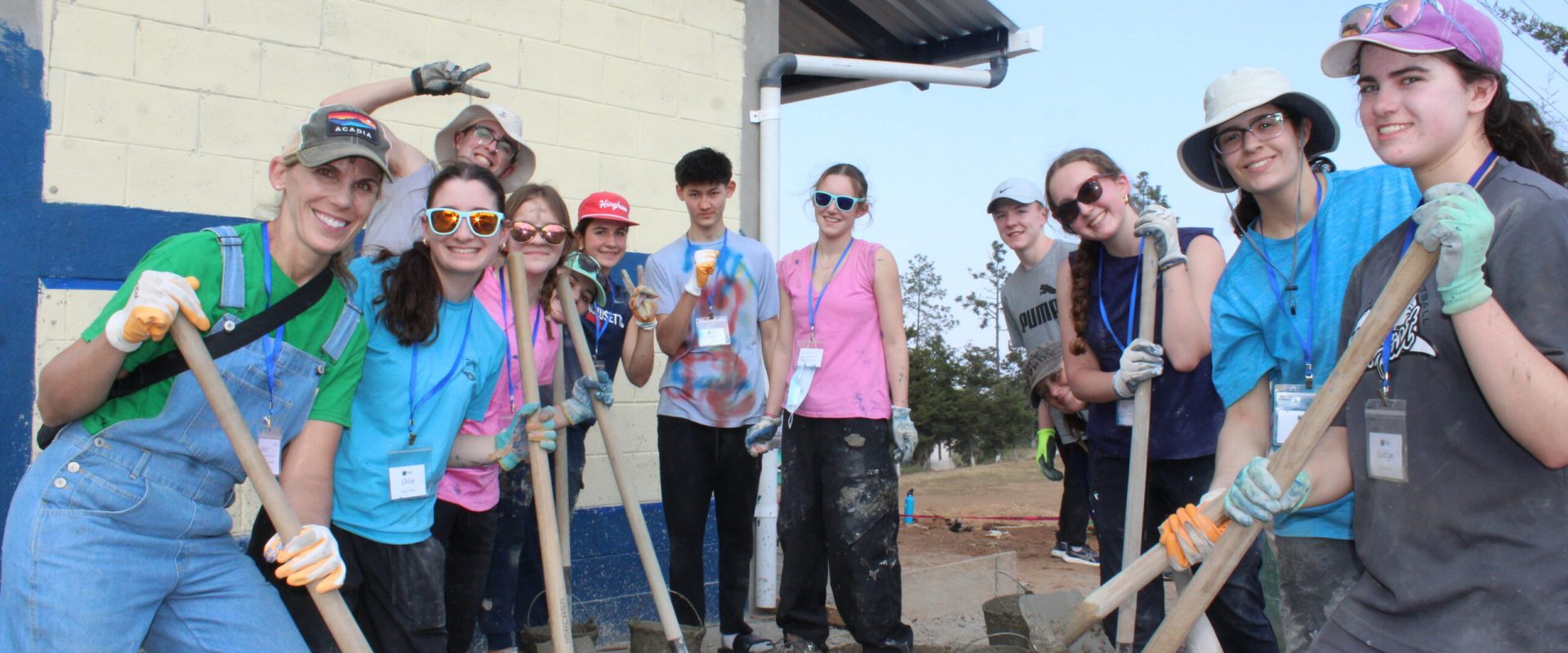
Students organize tools and materials and step into their first afternoon of service — mixing cement, painting classrooms, and preparing playground spaces that expand access to organized recess and play.
There is no spectator role. They are part of the team from the start.
By Tuesday, a rhythm takes shape.
Early breakfast. Make their lunch. Drive to the community. Morning service work. Mid-morning recess. More work before lunch. Afternoon service work. Time to play. Dinner and structured reflection back at the hotel.
The days are full — and intentional.
Sara F. wrote:
“Even though mixing the cement and carrying buckets was hard at times, knowing we were working to change the students’ lives made everything worth it.”
Clare C. added:
“I also learned a small part of what it is like to do manual labor.”
At recess, students step into School the World’s play initiative — building not just infrastructure, but opportunities for organized and free play that strengthen learning and life skills.
Alivia H. shared:
“Recess had some of the best moments. Playing soccer with the boys…”
Work and play are not separate from education here. They are part of the same ecosystem.
Midweek stretches students in a different way.
In small groups, they prepare and lead lessons for Guatemalan students. They navigate language differences, adjust in real time, and experience what it means to hold responsibility in front of a classroom.
Alannah T. described it this way:
“Being able to go with the kids as if I was a teacher and even a student myself.”
Alongside teaching, students continue service projects — including painting murals that brighten classroom walls.
Alannah T. wrote:
“The mural was a great addition to the classroom as I saw the kids loved the brightness and warmth it brought into everyone.”
By this point in the week, nervousness has shifted into participation.
Kenley M. reflected:
“I was not as scared about the language barrier.”
Thursday continues the rhythm of service work and recess — but it also includes home visits.
Students walk the same paths children take to school — sometimes long, uneven routes — and continue on to their homes. They see firsthand what daily routines look like and what responsibilities students carry outside the classroom.
For many, this is the moment the week changes completely.
Brooke C. wrote:
“The home visits especially made me realize that I need to be much more grateful for everything I have.”
And Evelyn K. described a moment that stayed with her long after:
“The elder of the house had said ‘I am grateful to see people from another culture before I die.’ I found this sentiment heartbreaking and heartwarming at the same time.”
The walk back to school feels different after that. Education is no longer abstract. It is connected to distance, time, family, and daily life.
The week culminates in a Dedication Ceremony attended by community leaders, families, and representatives from the Ministry of Education.
The completed classrooms, murals, and playground improvements are formally recognized. Parents and teachers speak. Students gather. The community prepares a celebratory lunch that all enjoy.
Caitlyn P. captured what that moment felt like:
“In the Dedication Ceremony, I felt the whole community’s gratitude and felt as though I made a family.”
Clare C. reflected on the tangible impact:
“I was really happy to see the impact the new classrooms and the playgrounds would have on the school.”
This moment reinforces something important: students were part of a broader effort to strengthen public education in a community committed to its children’s future. The ceremony is not the end of the story — it is one step in a multi-year partnership that includes teacher training, literacy programming, parent engagement, and ongoing school support.
School the World exists to disrupt extreme poverty through quality education.
For one week, students step into that mission — through construction, teaching, play, home visits, and reflection. It’s worth being honest: not every moment is perfect, and not every student arrives home with the same experience. Some find the pace intense. Some wish there had been more time.
But what comes through in nearly every reflection — from first-timers to returning students — is a shift that runs deeper than any single activity.
Jackson F., who had almost talked himself out of coming, put it plainly:
“My life has changed forever and I will never forget this week.”
And Caroline B. articulated something many students seem to feel but struggle to name:
“We may have been here to better the community’s education, but all of the incredible people here certainly taught me lessons I feel so honored to have received.”
The schedule is full. The work is real. The days are long. But the exchange — between students and community, between effort and gratitude, between showing up and being changed — is what makes this week unlike anything else.
If you’re interested in learning more about upcoming Student Service Learning trips or applying for a future program, visit our Student Service Learning page to explore dates, details, and next steps.