
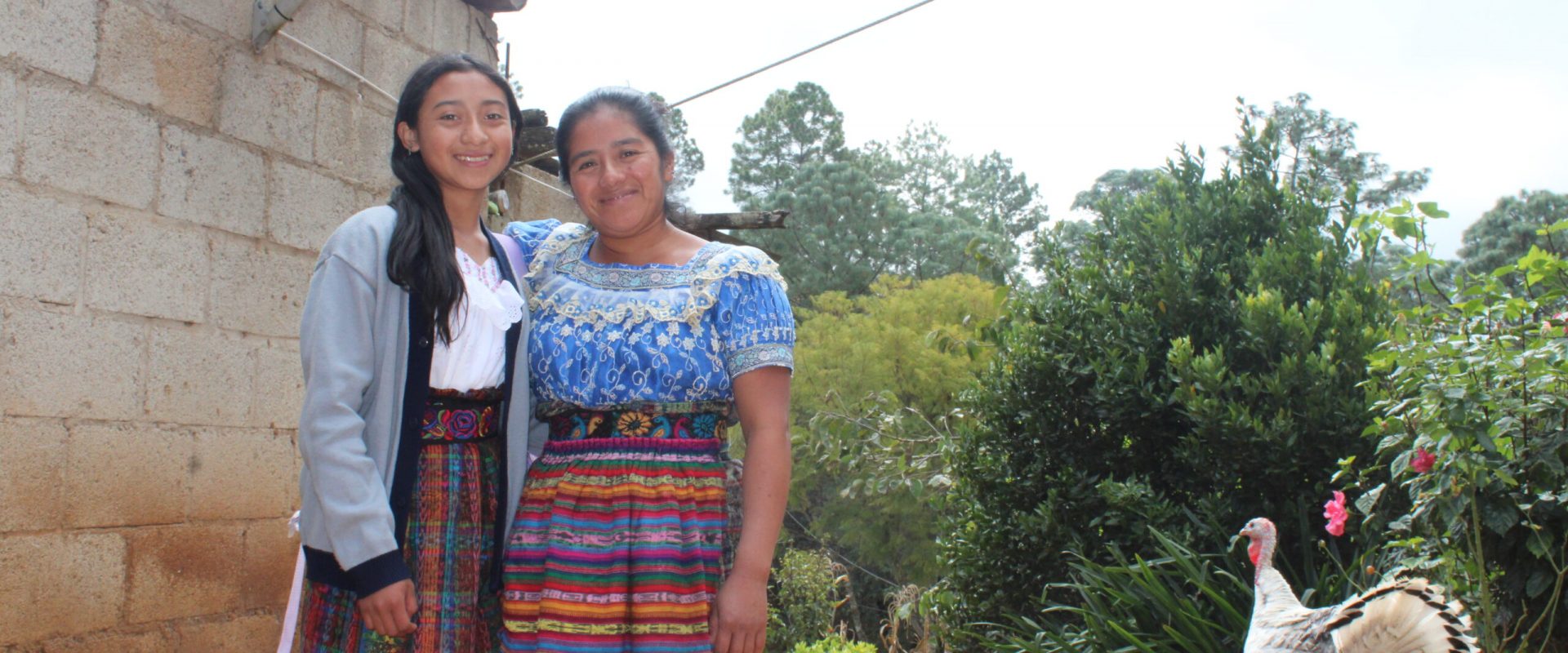
Before school starts, 14-year-old Yenifer sews traditional blouses with her mother. Together, they earn about $13 a week. After school, she returns to the sewing machine, then helps cook dinner, washes dishes and clothes, feeds the chickens and pigs, and cares for her five younger siblings.
At night, she studies mathematics—her favorite subject.
“I am like a ladder, that I want to go up, climb and go far,” Yenifer says. “I want to be the first Accountant in my community.”
Across rural Guatemala, girls supported by School the World (STW) aren’t just students. They’re income earners, family caregivers, business assistants, community helpers, and future breadwinners. They balance adult responsibilities with childhood dreams, carrying burdens that would overwhelm many adults—while still maintaining high grades and ambitious goals.
Their stories reveal a profound truth: when we invest in these girls’ education, we’re not just creating students. We’re empowering the economic and emotional engines of entire families.
Being the oldest daughter in a rural Guatemalan family often means becoming a second parent before you’ve finished being a child yourself.
Yenifer, the oldest of six siblings, has been working since age seven. While other children played, she learned to sew. Her father is a farmer and an alcoholic; what little he earns goes to buying alcohol. The family’s survival depends on what Yenifer and her mother can produce with needle and thread.
When Yenifer graduated from sixth grade, she was happy—and devastated. “I want to keep studying. My parents do not have money. What can I do?” she remembers thinking. “I not only want to take care of my little siblings, clean the house, cook, wash clothes and dishes, feed the chickens, the pigs; I want something else: I want to be a professional!”
Sandra, 14, is also the oldest of four siblings. Her daily routine includes feeding pigs, cows, chickens, ducks, turkeys, her cat, and dog, plus all the household chores, cooking, and feeding her younger brothers and sisters. Her mother never finished school—she had to leave as a young girl to wash clothes in other people’s homes to help support her own parents.
“I don’t want that!” Sandra says firmly. “My mom wants a different life for me!”
Both girls now have STW scholarships. The relief in their families is palpable—not just because the girls can continue their education, but because the financial burden has been lifted just enough to breathe.
“My parents are also happy because it’s a huge help with household expenses!” Sandra explains. “Money doesn’t stretch far enough, especially when my siblings get sick because we have to buy them medicine.”
Even the youngest girls supported by STW carry responsibilities that extend far beyond homework.
Eight-year-old Paulina helps her grandmother run a small business selling salt, sugar, and beans. Before she learned to write clearly in STW’s literacy program, she couldn’t help with the business. Now she writes prices and product names. “Before I couldn’t and now the letter comes out pretty,” she says with pride.
But her role goes deeper. In a community where literacy rates are low, Paulina has become essential. “I also help my grandmother, when they leave important papers (letters) in the community and I can read them to her.”
At age eight, she’s already a translator of the official world for her family.
Her classmate Sandra, also eight, has found her calling as a peer educator. “Thanks to teacher Estéfany, I can now help my classmates. I like to help them in class! Since I know more now, I read faster and finish quickly, I help my classmates to learn more.”
These stories could be heartbreaking—and in some ways, they are. Children should not have to be economic contributors or primary caregivers. They should not have to worry about whether their families can afford medicine or food.
But here’s what makes STW’s approach different: the scholarships and educational programs don’t ask these girls to choose between helping their families now and building their futures. Instead, education becomes the bridge that allows them to do both.
Yenifer still sews with her mother. But now she also studies accounting and dreams of working in a bank. “I want to improve my life, have a life different from theirs. I want to be brave and not be afraid to surpass myself.”
Sandra still helps with all the animals and household chores. But now she’s also learning to be a trilingual secretary, mastering Spanish, English, and K’iche’. “I can already say ‘good morning, good afternoon, good night, and bye’ in English,” she says proudly.
Young Paulina still reads letters to her grandmother. But now she’s also discovering literature she loves. “I really like to see the birds, because they fly high and the sound they make, I really enjoy it!” she says, describing why she loves reading and writing the word “águila” (eagle).
Perhaps the most powerful element of these stories is how clearly the girls understand what’s at stake.
Sandra’s mother tells her about washing clothes in other homes from childhood. Yenifer’s family shares their history—”it is nice, but I want another story for myself,” she says.
These girls aren’t rejecting their families or their heritage. They’re expanding what’s possible for the next generation.
“I want my family to be proud of me. We are very poor! Someday I want to have a bigger house and make my family happy. We all sleep and live in the same room; we are very tight,” Yenifer explains. “But that is going to change and thanks to everything that STW gives me and to people so kind like you, I am closer to my dream and a better future.”
The gratitude in her voice is profound: “Every night and with great joy, I thank God for this opportunity and I pray for people so nice like you, who are helping me; because if it were not for you, I do not know what my life would be like.”
When STW provides a scholarship to a girl like Yenifer or Sandra, we’re not just helping one student. We’re:
These girls already know how to work hard. They already know how to care for others. They already know how to contribute..
They’re not asking to be rescued from their responsibilities. They’re asking for the tools to transform those responsibilities into something more—for themselves, their families, and their communities.
“I am going to try very hard, be a great woman and one day, you will see me working in a bank!” Yenifer promises.
We believe her.
Every scholarship, every educational program, every trained teacher creates space for girls to be more than students—to be the multifaceted, capable, ambitious young women they already are, while building the futures they deserve. Support girls like Yenifer, Sandra, Paulina, Leidy, and Juana. Donate to STW today.
We just reached a historic milestone! Thanks to our community of supporters and local partners, we’ve officially dedicated our 200th school in Central America.
This isn’t just about a building—it’s about 17 years of community-led transformation and the start of a five-year commitment to the children of Tululché II.
From Guatemala to the Philippines, our co-investment model ensures every dollar you give creates a self-sustaining foundation for education.