
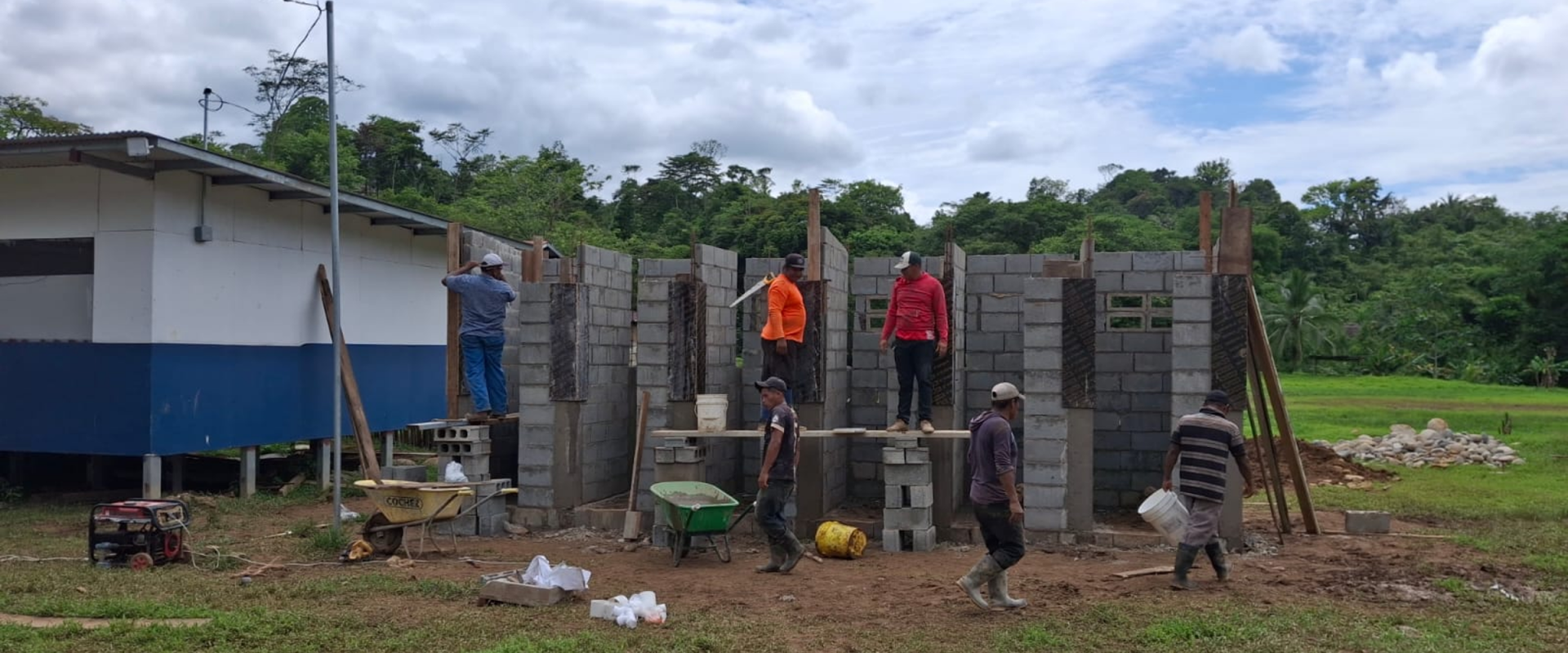
At School the World, we know that a school building is only the beginning. What determines whether children keep learning, year after year, long after our five-year partnership draws to a close, is whether families and communities have taken ownership of education as something that belongs to them. That means parents who show up. Fathers who invest. Community leaders who hold teachers accountable, co-fund school libraries, and bring their construction skills to bear when a classroom needs to be built.
This Father’s Day, we want to celebrate some of the men in our communities who are doing exactly that. Their stories span three countries and three very different kinds of courage, but they share something essential: a belief that education is worth fighting for, and that a father’s role in that fight is irreplaceable.
José Clemente Vasquez | Amates, San Francisco de Coray, Valle
José Clemente Vasquez is 55 years old. He lives in the small community of Amates in southern Honduras, where School the World runs an alternative education program for adults and out-of-school youth who never had the opportunity to complete their studies the first time around.
This year, Don Clemente graduated. At 55, he earned his ninth-grade diploma.
His path wasn’t easy. Going back to school as an adult, sitting alongside teenagers, doing homework after long days of work, pushing through moments of doubt, takes a kind of bravery that most people never have to find. But Don Clemente showed up to every class. He said each one was worth it.
“Education gave me the opportunity to better myself and to prove to myself that it is never too late to keep learning. My effort today is a better future for my family and my community.”
What makes Don Clemente’s story particularly powerful is what it means inside his own home. His daughter is currently enrolled in the same program, working her way through eighth grade. She is learning alongside, and inspired by, her father. When he told her, “if I could do it, so can you,” it wasn’t just encouragement. It was proof.
This is what community-driven sustainability looks like in practice. When parents become learners themselves, they don’t just support their children’s education, they transform the culture around it. Don Clemente is a champion for education not because an organization told him to be, but because he lived it.
In the highland communities of Quiché, Guatemala, School the World’s parent engagement program brings fathers and mothers together for regular training sessions, building the knowledge, confidence, and sense of ownership they need to become true advocates for their children’s education. This Father’s Day, we’re honoring three fathers (and two tijoneles) whose participation in this program reflects exactly the kind of community leadership we are working to build for the long term.
Ventura Castro | Los Hernández Community
Ventura Castro participates in every training session School the World offers in his community, not because he has to, but because he understands that showing up is one of the most important things a father can do. Through the program, he’s learned why school attendance matters, why parent involvement at school meetings makes a difference, and why none of it can wait.
“I am very happy to be participating in the School The World training sessions. Thanks to them, I know how important it is to send children to school and that I need to attend all school meetings, because it is for the benefit of my children.”
Jerónimo González and Tomás Sucuqui | Los Tzoc, Chiché, Quiché
Jerónimo González and Tomás Sucuqui serve as tijoneles in their community, a term from the local tradition meaning men who step into caregiving roles alongside mothers, supporting families and helping with young children. It’s a role that breaks with longstanding gender norms in the region, and one that both men have embraced with pride.
Through their participation in STW’s training program, Jerónimo and Tomás have helped shift what it means to be a father and a community member in Los Tzoc. They’ve learned that gender doesn’t determine who can nurture, who can lead, and who can build a stronger future for the community’s children.
“Through the training sessions we have learned that gender does not matter when it comes to doing things, as long as they are done with great willingness and love. Helping in our community also makes us very happy.”
Don Felipe Solis Castro and Don Gilberto Morán Moran | San Antonio Ixoc and Esquipulas Pajuil
Don Felipe and Don Gilberto are two fathers who share something deeply personal: neither of them can read or write. And yet both show up, reliably, consistently, to School the World’s parent training sessions. Not because it’s easy, but because they’ve decided that their own limitations will not become their children’s.
Don Felipe speaks honestly about the sadness he feels when his children ask him for help with their homework and he can’t give it the way he wishes he could. But he has learned, through STW’s program, that support doesn’t require literacy. Asking “how was school today?” matters. Being present matters. Believing in your child matters.
For Don Gilberto, the transformation has been layered and visible. His children can now read, in large part because School the World brought books into their classroom through the school library program, which parents co-funded as a community investment. One of his daughters has received a scholarship that is allowing her to continue her studies beyond primary school. And Don Gilberto himself attends every training session, learning what he can, determined to keep pace with his children’s education.
“I cannot read or write, but thanks to the School the World training sessions I have learned that I can still support my children even with that limitation.”
Rafael Molina and Lucrecio Contreras | Ngäbe-Buglé Comarca
In the Ngäbe-Buglé Comarca, an indigenous territory in western Panama where School the World has been building school infrastructure and strengthening educational systems, two fathers stood out this Father’s Day as emblems of what community ownership truly looks like.
Rafael Molina is a father of three from the community of Druri. Two of his children have already graduated from sixth grade; his youngest is right behind them. Rafael’s dream, stated clearly and without hesitation, is that all three will finish university one day. He works multiple jobs to make it possible: a supermarket position in the city, his own farm, a small general store.
But what makes Rafael’s story especially meaningful for School the World is what he brought to a school construction project that launched in his community this year. Rafael has skills in carpentry and construction, practical knowledge built over years, and when the project began, he showed up not just as a beneficiary, but as a builder. His expertise became a direct contribution to the school his own children will attend. That is co-investment in the most literal sense.
Lucrecio Contreras, from the community of Cerro Miel, carries a different kind of weight. He is a father of five, a pastor in his community’s church, and, remarkably, a current university student. Four of his five children are in school. His eldest has already completed secondary school. Lucrecio is not waiting for opportunity to arrive. He is building it, for himself and for everyone watching him.
Together, Rafael and Lucrecio represent the vision that School the World holds for every community it serves: that when the five-year intensive partnership ends, it is men and women like them, deeply invested, deeply capable, who will carry education forward.
We share these stories with gratitude and with intention. Gratitude, because these fathers, and the many more like them across Guatemala, Honduras, Panama, and the Philippines, are the reason we believe this work is sustainable. And intention, because we want the people who support School the World to understand what their investment is truly building.
It is not just schools. It is not just libraries or scholarships or tutoring programs, as vital as each of those is. It is the culture that grows around them, the father who shows up to every school meeting, the man who lends his construction skills to the project, the grandfather who volunteers as a community leader so other parents don’t have to figure it out alone.
That culture is what outlasts us. And that is exactly the point.
This Father’s Day, consider supporting the fathers, families, and communities at the heart of this work. Donate today!