
During recess at a rural school in Guatemala, Katherine Gweth picked up a jump rope.
Within minutes, she was surrounded by younger students, taking turns, laughing, and finding ways to communicate without speaking the same language.
“It didn’t really matter that we couldn’t fully understand each other,” she said. “We just played.”
That moment stayed with her.
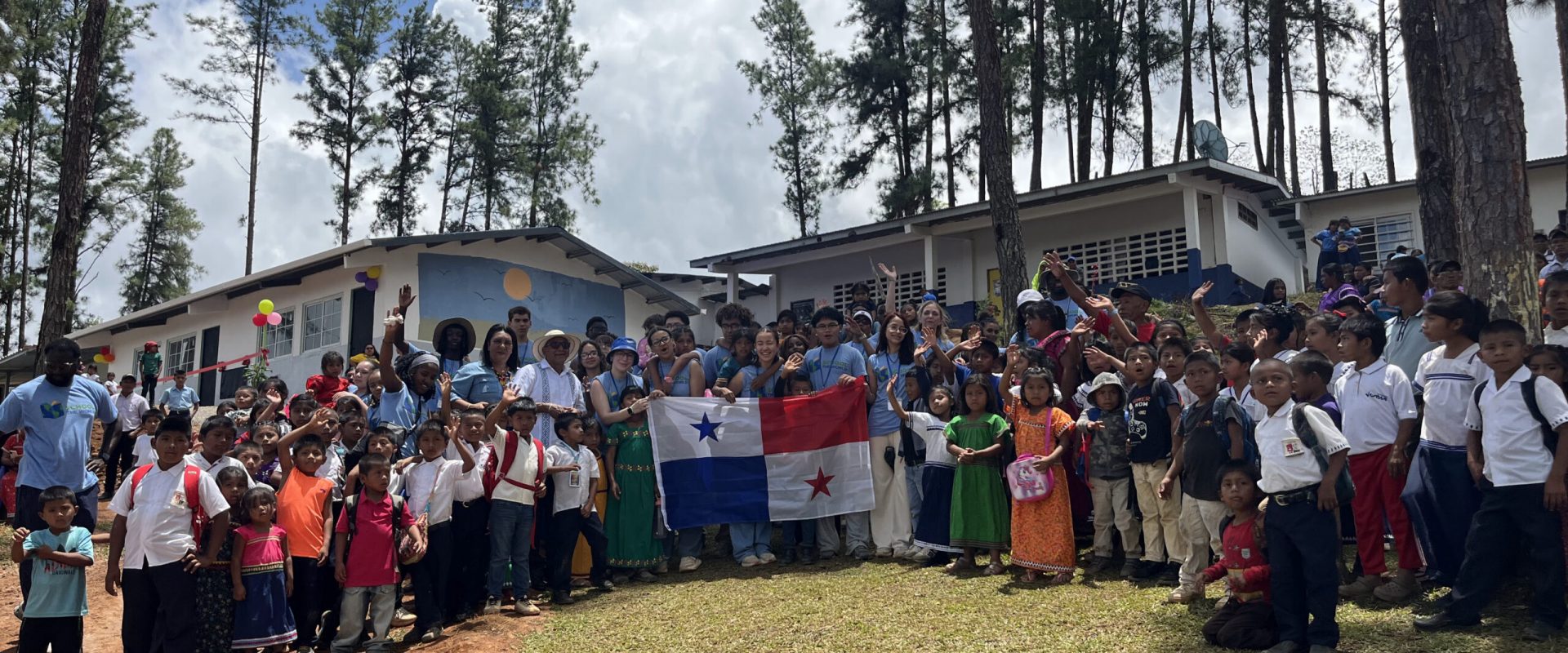
Gweth, a senior from Canton, Massachusetts, first joined a School the World trip through the Ron Burton Training Village (RBTV) in April 2025. This April, another group of 30 Boston-area students returned from Panama after spending eight days building classrooms, painting murals, and refurbishing playgrounds alongside local families and students.
The trip is part of an eight-year partnership between School the World and RBTV—one built on a shared belief: that developing young people as leaders and expanding access to education are deeply connected.
For more than three decades, the Ron Burton Training Village has invested in the long-term development of young people.
Students enrolled in “The Journey” participate in a seven-year program, receiving year-round mentorship and training in education, leadership, social skills, values, and physical fitness. The goal is not just short-term growth, but helping young people achieve their purpose despite life’s challenges.
That philosophy is rooted in the vision of its founder, Ron Burton Sr., who believed that character is built over time—and that young people need both structure and opportunity to grow into leaders.
School the World’s work begins in a different place, but arrives at a similar goal.
In rural communities across Central America, the organization partners with local governments, educators, and families to strengthen public education systems—building schools, training teachers, empowering parents, and supporting students over a five-year period. Every year students visit Honduras, Panama, and Guatemala through the service learning program to contribute to these initiatives, both through their financial support and labor.
“When we think about impact, it’s not just about building classrooms,” said Kate Curran, Founder and CEO of School the World. “It’s about building systems that allow children to learn, and communities to sustain that learning over time.”
The partnership between RBTV and School the World brings these two approaches together.
RBTV prepares students over years. School the World provides the context where those skills are applied.
For eight days on the ground, students step into communities where the work is already underway. They don’t start the process—they join it.
This year in Panama, that meant helping complete two classrooms, painting four murals, and refurbishing two playgrounds alongside local families and educators.
The work is structured. The goals are clear. But the environment is unfamiliar.
“They’ve been trained,” said Phil Burton, Executive Director of RBTV. “Now they have to apply it somewhere completely different.”
The shift happens quickly.
On a past trip, when a group of students arrived at a site and saw piles of sand and rocks, one asked where the cement truck was.
“There is no cement truck,” Burton said. “You are the cement truck.”
The expectation is immediate. Students move from observing to doing—mixing cement, carrying materials, and working together to complete the project.
But what stays with many of them extends beyond the work itself.
For Gweth, one of the most impactful moments was visiting the home of a family of eight living in a small two-room house, where the mother managed the household while the father recovered from an accident.
It shifted how she thought about her own life.
“I came back more independent and more grateful,” she said. “It made me appreciate everything my mom does.”
Inside the classroom, other moments stood out. Students noticed differences in resources, but also the level of engagement—children eager to learn, participate, and connect.
These are not abstract lessons. They are experiences students carry with them as they return home.
At first glance, the missions of RBTV and School the World may seem different—one focused on youth development in the United States, the other on education systems in Central America.
But at their core, both are working toward the same outcome: creating the conditions for individuals and communities to thrive.
For RBTV, that means preparing young people over years to lead with character and purpose. For School the World, it means working alongside communities to ensure children have access to the education they need to build their futures.
Together, the partnership creates something neither could do alone.
It gives students the opportunity to contribute meaningfully to long-term work, while gaining firsthand understanding of the role education plays in addressing poverty.
Eight years into the partnership, more than 120 students have participated in trips to Guatemala and Panama.
Each group builds on the work of the last—both in the communities they serve and in the students who return home with a broader understanding of the world around them.
“We’re not asking students to solve these challenges in a week,” Curran said. “We’re inviting them into work that continues long after they leave and giving them the chance to learn from the communities leading it.”
That combination—long-term partnership, shared purpose, and real responsibility—is what continues to define the collaboration between School the World and the Ron Burton Training Village.
This work is made possible through the support of donors who invest in both long-term education initiatives and the development of young leaders.
To learn more about School the World’s Student Service Learning program or support this work, visit our student service learning page.
Join our newsletter and get the latest updates
By signing up, you agree to receive emails from School the World, Inc..