
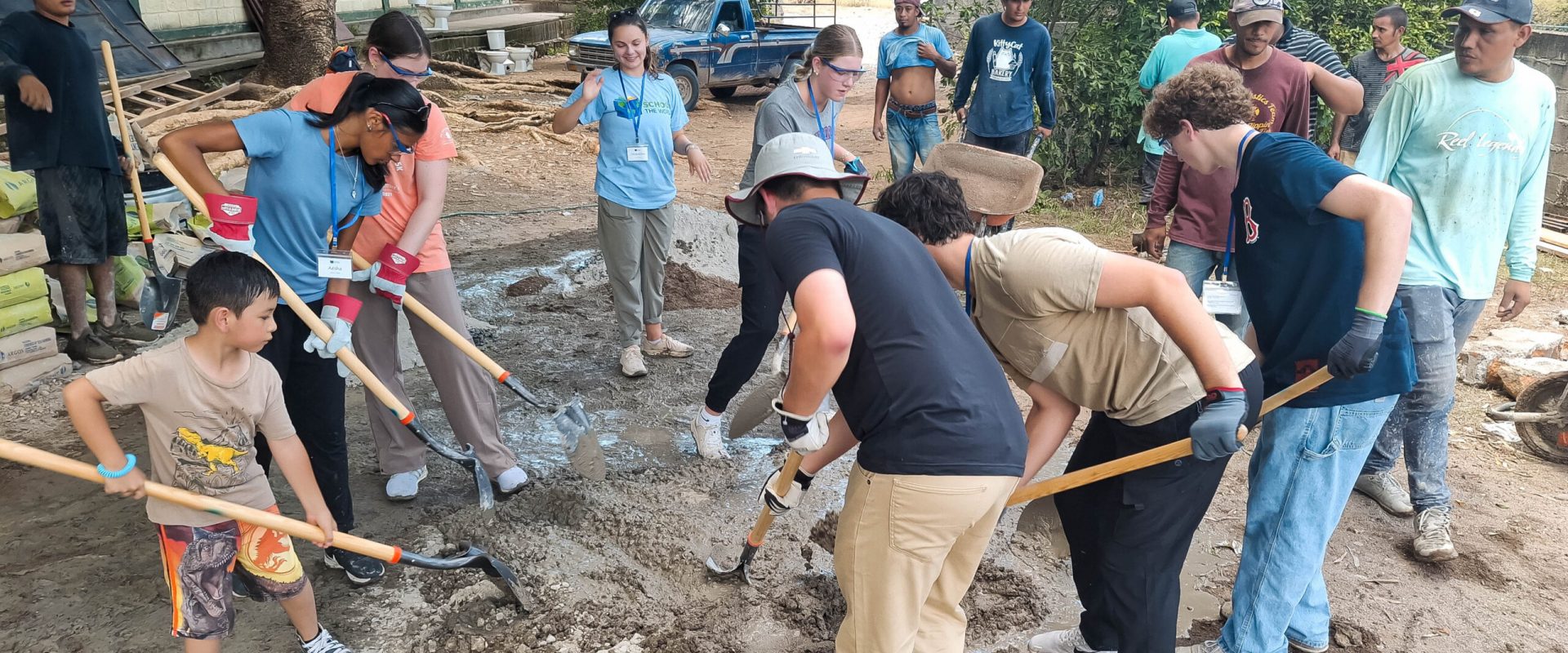
Nearly ten years ago, a high school student from Massachusetts embarked on her first School the World trip to Guatemala. Jacqueline Fanning went because friends were going, and the idea of traveling somewhere “really cool” while helping with something school-related sounded exciting. She had no idea that this week would shape the trajectory of her life.
Today, Jacqueline is a 7th and 8th grade math teacher who has returned to School the World six times as a chaperone over the past three years. Across all her trips—as both student and chaperone—she’s traveled to all three countries: Guatemala (four times), Panama (twice), and Honduras (three times). Her story offers a unique perspective on what these trips mean, both in the moment and over time.
Of all her experiences across all her trips, one memory from her very first journey remains vivid. During recess time, Jacqueline and her friend were chatting with a woman from the community whose house backed up close to the school. Trying their best with “very poor Spanish,” they exchanged names, and the girls held up their name tags to show theirs.
The woman told them she couldn’t read.
“That definitely has stuck with me for a while,” Jacqueline reflects. “I remember being like, wow—in other contexts, I would always assume that a woman old enough to have kids would be more educated than me, a high schooler. But she couldn’t read.”
It was a jarring realization about educational privilege that she didn’t expect. She now shares this story in debrief groups when she leads trips as a chaperone, helping new students understand the profound impact of what they’re witnessing.
When Jacqueline signed up for that first trip as a 16-year-old, she thought, “I get to go to a really cool place, I get to help with something, and I get to do some teaching and school-related things—all things that I’m interested in.” But the reality went deeper.
“I didn’t realize the extent of how necessary the situations they were in,” she explains. “This wasn’t just a ‘we got to update our school’ situation. They didn’t have classrooms. They didn’t have these things that we have. So we’re not just helping make something better—we’re actually just making something exist in the first place.”
As a high schooler, she hadn’t understood that places existed in the world that were so rural, with such limited access to education, where students couldn’t continue school after middle school. Walking back into her own high school after returning home, she experienced profound culture shock. “I remember just going to school the next day and being like, ‘Wow, I’m pretty lucky, aren’t I, that I have all of these things?’”
The trip also affirmed her career path. Already planning to apply to college as an education major—she liked working with kids and coached gymnastics—the experience made her certain. “This definitely made me sure that I was choosing the right path for myself.”
Jacqueline and her friends worked hard to make those high school trips possible. They organized car washes and bake sales. She and Kate’s niece Olivia both worked at the same gymnastics center, where they made hair ribbons to sell. They pulled out every stop they could think of.
“That definitely taught me how to work for something that you want,” Jacqueline says. “It wasn’t a vacation that I was just going to be able to pay for. I was also a high schooler.”
That experience instilled something lasting: “I definitely think that has made me more understanding and appreciative of when people are fundraising or doing things like that since, because I know that it can be difficult and a lot of work.”
Now, as a middle school math teacher who leads groups of students through these same experiences, Jacqueline brings unique insights. During evening Rose and Thorn reflections, she encourages students to think about what’s different for a high school student in the community they’re visiting versus their own lives back home. “When they’re reminded that these are essentially their peers, they have a different perspective, for sure.”
She also makes sure students understand School the World’s lasting impact. “A lot of the students who come on the trip know what they’re going to do on their trip, but they don’t really understand School the World’s impact after,” she observes. “I always like to explain to them—we leave after this week, but School of the World’s not leaving after this week. And all the things that come next, that’s just the beginning.”
As a teacher herself, she’s constantly impressed by what local educators accomplish with limited resources and shorter school days. She shares these observations with students, helping them see the trip through multiple lenses—not just as teenagers experiencing something new, but understanding the educational challenges and triumphs happening around them.
For parents considering chaperoning a trip, Jacqueline offers this wisdom: “Just because you’re a chaperone doesn’t mean that you shouldn’t use this as an immense learning experience. You should immerse yourself with the community just as much.”
She’s observed different approaches from parent chaperones over the years. Some dive fully into construction work, engage at recess, ask questions, and have conversations with community members. Others hang back and choose a more observational role. Both are valid choices, she notes, but there’s so much more to gain from full engagement.
“You can get so much more out of it when you’re really diving into all these things and having these conversations or asking questions about what’s going on around you,” she emphasizes. “Be curious like you would be when you were a kid.”
Jacqueline has only had the chance to return to one community—the very first one she visited in Guatemala. When she went back a year later on her second trip, she saw familiar faces and reconnected with a girl she’d bonded with the year before. Though many memories from a decade ago have faded, the impact hasn’t.
Last summer in Honduras, students on her trip were returners who got to revisit the community they’d been to the previous year. Even though Jacqueline stayed with a different group, she heard all about how the community had changed and progressed. “That was really cool to see it through their lens, but also I was a part of that community too, so it’s nice to hear about it.”
It’s this continuity—students becoming chaperones, communities transforming year after year, and one person’s ongoing commitment—that exemplifies what School the World makes possible. Jacqueline’s journey from that uncertain first trip as a teenager to now helping shape similar transformative experiences for others shows how a single week can echo through the years.
Jacqueline continues to teach 7th and 8th grade math while chaperoning School the World trips during her school breaks. She’s proud that the Needham community where she started still sends “such a huge group every single year—I feel like it never stopped.”