
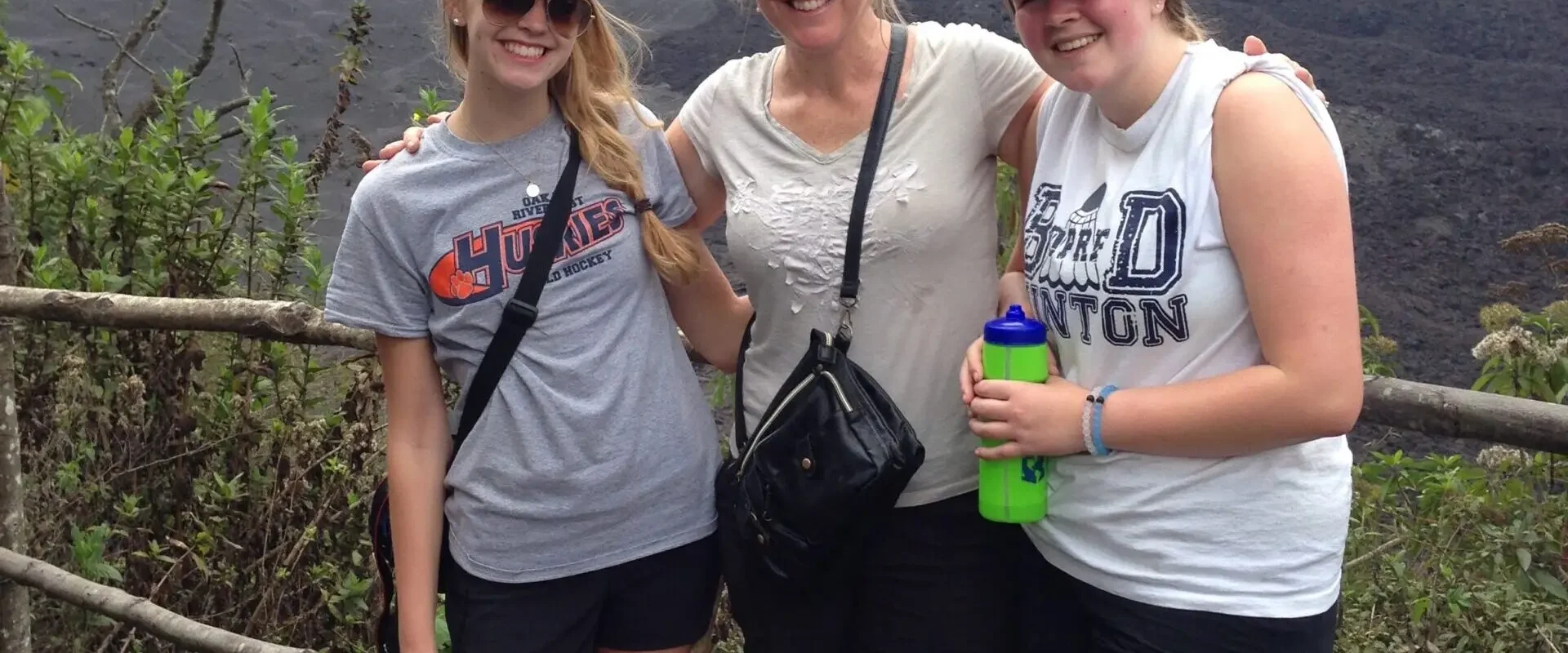
For Karen Crowley, service learning was never a new concept. It had been part of her life for years, first as a student, then as a teacher and school psychologist, and later through her own volunteer work in Central America.
So when she first learned about School the World through a college connection with founder Kate Curran, its mission didn’t feel unfamiliar. It felt aligned.
As she put it, it had “always been a piece of my life… when I had kids, I just naturally introduced them to it.”
For Karen, introducing her three daughters—Shea, Robyn, and Grace—to service wasn’t about adding another activity. It was about helping them understand something she had come to believe deeply: that education has the power to change lives, and that meaningful service is rooted in connection, not charity.
All three daughters would go on to participate in School the World trips at different points in their lives, sometimes together, sometimes separately, and occasionally alongside their mom.
But not all service-learning experiences are the same. From Karen’s perspective, what made this one meaningful came down to a few key elements.
One of the things that stood out most to Karen was the tone of the experience. It wasn’t framed as “look what good we can do.” Instead, it felt like a shared experience, one where everyone involved had something to gain.
“It wasn’t like… ‘look what good we can do.’… it feels more like it’s a win-win on both sides.”
Rather than positioning students as outsiders coming in to fix something, the program created space for mutual learning. Students could engage with communities, build relationships, and better understand the role education plays in different contexts.
That distinction mattered. It shifted the experience from something performative to something personal.
As an educator, Karen has always believed in the long-term impact of education. She has seen firsthand how access to quality education can change the trajectory of a life.
“You can change people’s lives if you have good education.”
What resonated with her about School the World was that service learning wasn’t the end goal. It was one part of a broader, community-based approach to strengthening education systems.
Students weren’t just participating in a one-time experience. They were stepping into ongoing work led by communities and focused on lasting change.
For Karen, one of the most important elements wasn’t what happened during the day. It was what happened after.
“It wasn’t just that you go… there’s some reflection time.”
Through guided conversations and structured reflection, students were encouraged to process what they were seeing and experiencing.
That space to think, ask questions, and make meaning helped turn the experience into something more lasting. Without it, she noted, it would be easy for everything to blur together.
As both a parent and a chaperone, Karen saw another layer of value: the opportunity to experience it alongside her daughters.
“It’s just a really cool thing to share with your kids… to watch your child experience something new and grow.”
Being there allowed her to see those moments firsthand and to continue the conversation long after the trip ended.
“Then the conversations are after… because you’ve experienced it together.”
That shared context made the experience more than a one-time event. It became something the family could revisit and reflect on over time.
Like many parents, Karen thought carefully about what kind of experience this would be for her daughters. Her prior connection to Kate gave her an initial level of trust, but it was the organization’s preparation and communication that reinforced it.
Participants were given clear expectations, logistical guidance, and thoughtful introductions to the communities they would be visiting. That preparation helped ensure that students arrived ready not just to participate, but to engage with intention and respect.
Looking back, Karen doesn’t point to a single moment as the most important part of the experience.
Instead, she sees its impact in how her daughters continued to engage with the world around them. Each of them carried those values forward in different ways, shaped not just by one trip, but by a series of shared experiences over time.
For parents considering a service-learning experience, her advice is simple: look beyond the trip itself.
Look for something that centers learning, not just doing.
Something that connects to real, ongoing work.
Something that creates space for reflection.
And, when possible, something you can share with your child.
Because at its best, service learning isn’t just about where you go. It’s about how it shapes the way you see the world, and what you choose to do next.
School the World’s service-learning program invites students and families to engage alongside communities working to strengthen education systems over time.
If you’re interested in learning more about upcoming trips or how to get involved, visit School the World’s Service Learning Program page or connect with our team to explore the right opportunity for your family.
Join our newsletter and get the latest updates
By signing up, you agree to receive emails from School the World, Inc..