

When School the World launched our Continuing Education or Second Chance Program in Guatemala in 2021, the program was built on a straightforward premise: there are people in rural communities who want to continue their education, and the traditional school system hasn’t made that possible for them. What we didn’t know yet was whether a flexible, center-based alternative could actually get them to a government-recognized credential.
Five years in Guatemala, and two in Honduras, we now have data to answer that question.
We recently completed our most rigorous internal review of the Second Chance program to date, tracking 1,693 students across more than a dozen communities in both countries. Second Chance prepares students for and supports them through Guatemala’s and Honduras’s official national examination systems. The credentials students earn are the same ones issued through the formal school system, recognized by government, employers, and universities alike. What follows is what we found, including the things we’re still working to understand.
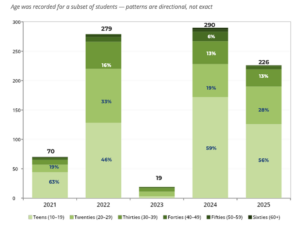
Second Chance offers secondary-level education to youth and adults who haven’t been able to complete school through traditional pathways. In Guatemala, that includes primary equivalency (PEAC), middle school (Básico), and high school (Bachillerato) credentials. In Honduras, where the program launched in 2023, it offers the Bachillerato credential only.
The students who enroll are not a homogeneous group. Teenagers are the largest share in every cohort, but adults in their 30s, 40s, and beyond make up a meaningful portion of enrollment. Age doesn’t predict who completes the program. Our statistical analysis found that older students do as well or better than younger ones at the higher credential levels. The “second chance at any age” framing is empirically supported.
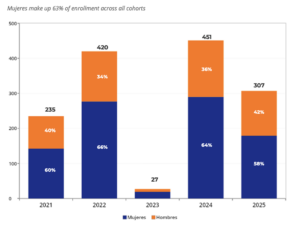
Women make up 63% of enrollment in Guatemala, and 58% in Honduras, without any targeted recruitment. This likely reflects who has been most underserved by the formal education system.
The most important finding from five years of Guatemala data is also the most clarifying: what a student earns is largely determined by where they start.
Students who enter at the PEAC level almost universally leave with a PEAC credential. Students who enter at Básico complete Básico. The program is most accurately understood as a credential-by-credential intervention that meets students where they are. For many students, that next credential is the first recognized academic achievement they’ve ever held.
That said, a meaningful minority do climb. Among students who entered at Básico I, 9% ultimately reached Bachillerato. Among PEAC II entrants, 29% went on to complete Básico. These aren’t the majority, but they represent students who came in with momentum and kept going, and their trajectories point to what becomes possible when the program meets someone early enough in their education journey.
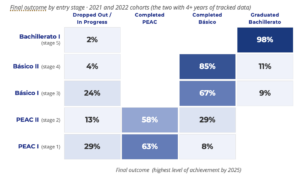
Among students who enroll at Básico I, the program’s most common entry point, 61% of the 2021 cohort and 52% of the 2022 cohort have now completed Básico II. More recent cohorts are still in progress and not yet comparable.

Honduras launched in 2023 and is Bachillerato-only. Three cohorts in, the early signals are positive. Of students with tracked outcomes in the 2023 cohort, 96% completed Level 8 and 74% reached Level 9, the program’s top credential, within three years.
The one-level-per-year design shows up clearly in the time-to-completion data: 92% of Level 9 graduates completed it in exactly three years, consistent with entering at Level 7 and climbing one level per year.
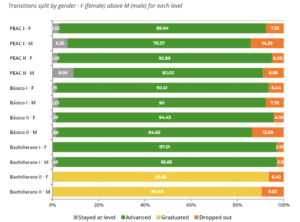
Across both countries, women complete credentials at higher rates than men. In Guatemala, male students drop out at roughly double the rate of female students at the PEAC and Básico II levels. In Honduras, a similar gap emerges at Levels 8 and 9. By the time students reach the top credential, the difference narrows, partly because the students who persist that far are a more self-selected group regardless of gender.This is the program’s most consistent pattern across both countries, and one the data raises more questions about than it answers.
The program’s design means outcomes take time to measure. Students who enrolled in 2024 and 2025 have had one or two years in the program, which isn’t enough time to assess their full trajectories. We also can’t yet fully distinguish between students who have left the program and students who are progressing at a different pace.
1,693 students have enrolled in Second Chance since 2021. Of those with enough time in the program to have realistic completion trajectories, the data is encouraging. At every level, students who stay in the program advance. The challenge isn’t progression. It’s initial enrollment, and keeping students engaged in the first year, when the risk of leaving is highest.
Rigorous data collection is central to how we run this program. We track enrollment, attendance, semester progression, and credential completion across every cohort and community, and we share findings with local partners and government officials as part of an ongoing conversation about what works. That analysis directly informs how we think about program design, where we recruit, and how we deploy support.
Behind the data are real stories of real impact. We’d love to introduce you to a few. You can read more about Second Chance students in this blog post or watch videos of Wilfredo and Catarina.