
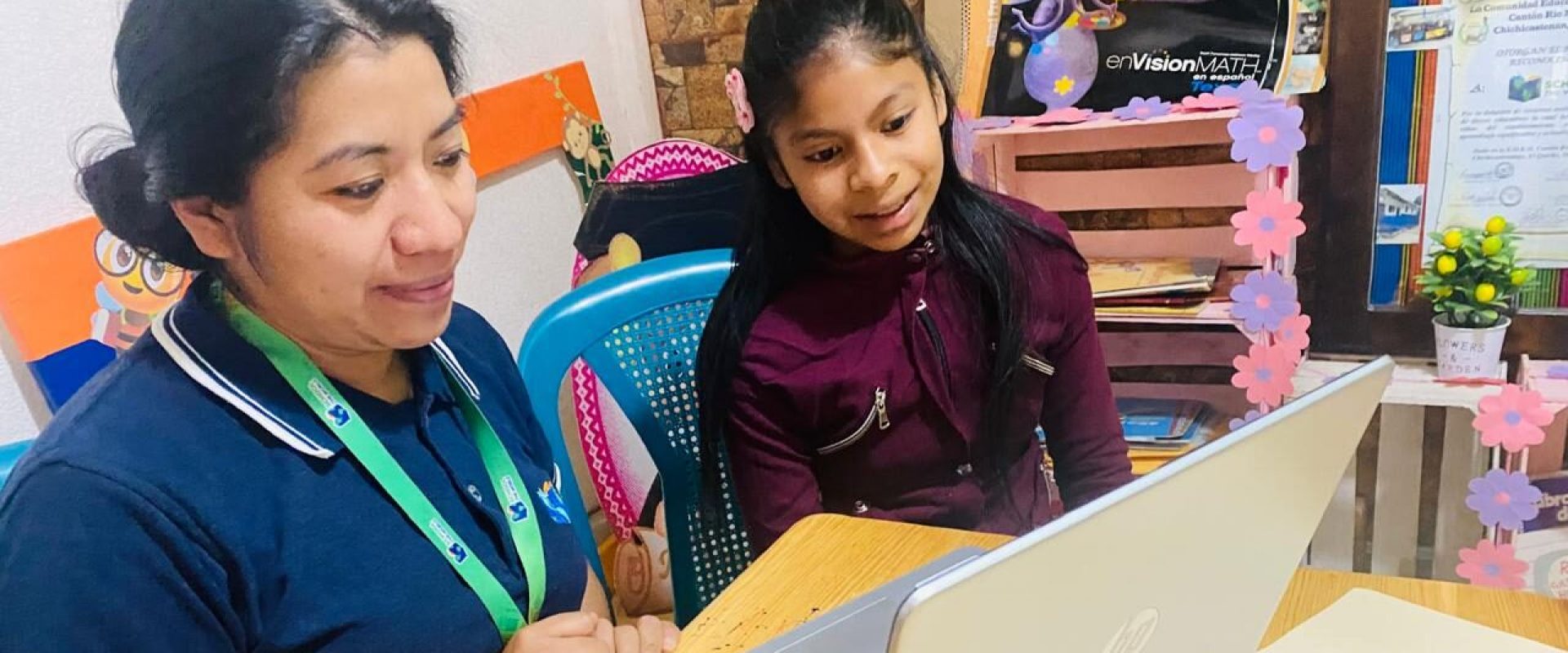
Growing up as the youngest of seven children in Chinique, a small municipality in Guatemala’s Quiché department, Rosa Pérez was surrounded by the steady rhythms of family commerce. Her father traveled to Guatemala City for work, trading and doing business, while her mother ran a neighborhood grocery store — an abarrotes — with the help of her children. Being the baby of the family had its perks: Rosa was doted on by her siblings, and after her turns helping at the store, she could always retreat to her studies.
Education was never a question in her household. Both parents made clear that Rosa would keep going — through básico(middle school), through diversificado (high school), and beyond. “My mom always supported my studies,” Rosa recalls. “She was always there.” When Rosa completed ninth grade, her mother had a specific dream for her youngest daughter: she wanted Rosa to become a secretary, a stable and respectable path. Rosa, ever the dutiful daughter, enrolled — but she already knew it wasn’t her calling. She quietly registered for social work at the same time. “I said to myself: I’ll give my mom the secretarial credential to make her happy, and then I’ll study what I really want.”
The seed of that calling had been planted years earlier, by her sister Magdalena.
Magdalena was a social worker, and Rosa watched her with wide, curious eyes. She would tag along when Magdalena went out to communities for her university practicum, peppering her with questions: Why do you call these people together? Why do you coordinate with the cocodes? — the community development councils through which local leaders organize and drive change. Magdalena’s work at the time centered on food security and community nutrition, and Rosa was mesmerized: not just by the subject matter, but by the way her sister gathered people, came prepared, and made things happen.
“She was my inspiration,” Rosa says simply. When Rosa later arrived at the university to enroll in social work, she ran into former classmates of Magdalena’s — twin sisters who immediately recognized her. “You’re Magda’s sister!” they exclaimed. She was. And in that moment, following in her sister’s footsteps felt like exactly the right thing to do.
Her mother’s influence ran just as deep, if differently. Where Magdalena showed Rosa what was possible professionally, her mother modeled something quieter and equally powerful: perseverance, entrepreneurship, and showing up every day. Rosa has carried that spirit into her own life — she now runs a small food business on the side, selling tostadas and embutidos after her workday ends. “My parents were always in business,” she says with a smile. “I guess that stayed with me.”
By 2020, Rosa had graduated as a social worker and was already employed, leading programming across 32 communities focused on women’s empowerment. Then, in the early months of the pandemic, she saw a job posting that stopped her in her tracks. School the World was looking for a scholarship coordinator. The organization was based in Santa Cruz del Quiché, the same region where Rosa had grown up. And they were working with young people — exactly the population she had always wanted to serve.
“When I saw that notice, I said: this is for me.”
She resigned from her position and traveled to Santa Cruz del Quiché to interview, nervous but certain. She had done her research: looked up School the World online, learned about the school construction work happening in communities like hers. The more she found, the more she wanted in. “I was very nervous,” she admits, “but it was a beautiful experience.”
She has been with School the World ever since.
Today, Rosa works directly with scholarship recipients — students who, with the right support, can stay in school and build toward futures they’ve chosen for themselves. She brings professional tools and deep personal understanding to this work in equal measure.
She uses techniques like the FODA (a SWOT analysis adapted for students), positive-negative-interesting (PNI) reflection exercises, and — perhaps her most beloved tool — the plan de vida, or life plan. Students build these through drawings, photos, and personal reflection, mapping out not just their dreams but their daily schedules: what time they wake up, when they do homework, when they help at home, when they read. “It has to be realistic,” Rosa says. “That’s how they hold themselves accountable.”
She is direct with students about personal responsibility too. “I always say: who goes to school? The student. Not mom. You go.” It’s a message she delivers not with judgment, but with genuine belief in what each student is capable of.
For girls, the stakes are even higher — and the barriers more specific. Rosa is candid about the discrimination she encounters in the field. She will visit a family and hear a father say plainly that there’s no point educating his daughter because she’ll just get married. Rosa doesn’t argue. She reframes. “I tell them: your son gets married too. He has responsibilities. Your daughter gets married — she has responsibilities. If you take away her education, you’re not helping either of them.”
With the girls themselves, she poses a different kind of question: “Right now you’re at the tortillería, earning 40 quetzales, waking up at 4 in the morning, going to sleep at 10 at night. Don’t you want something different?” It is not a lecture. It is an invitation to imagine — and to plan.
Rosa is also honest about what has changed. More parents — including fathers — are beginning to see their daughters’ education as an investment worth making. “Now we see parents motivating their daughters,” she says. “That is in our favor.”
Rosa’s own story is still being written. In 2024, she married, and her son Kennedy Yeray arrived to make her already full life even fuller. A master’s degree in higher education, begun just before the pandemic disrupted everything, remains unfinished — the cost is steep and the timing hasn’t been right. “This year it will be impossible,” she says, “but maybe next year.”
“I believe each person achieves things when they set their mind to it,” Rosa says. “I set my mind to graduating from university. I did it. And I’m here.”
For the girls she works with every day, that is exactly the point.
School the World partners with local communities to build schools and support students across Central America. Scholarship support helps students stay in school in middle school and beyond.