
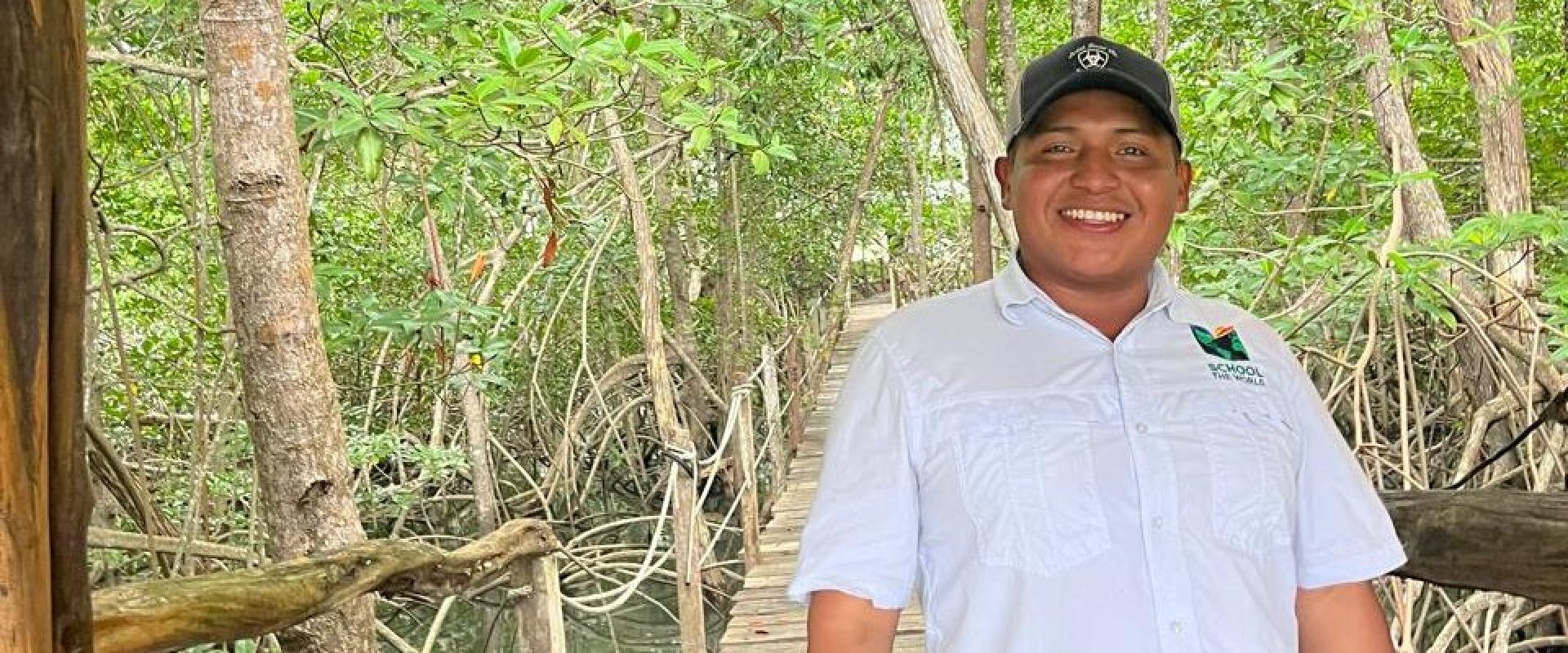
When Aaron Molino won School the World’s 2026 Above and Beyond Award, for outstanding contributions and perseverance in advancing the organization’s mission, he immediately called his father. “I feel like they congratulated me too,” his dad told him. It was a fitting response from a man who once worked as a boat driver, security guard, tailor, lumberjack, cowboy, and carpenter—all to ensure his children could get an education.
Aaron’s story begins in Barote, a remote indigenous community in Panama’s Ngäbe-Buglé comarca—an area so isolated that boats are the primary means of transportation between communities. “There’s still no road,” Aaron explains, “though the government is working to connect these remote communities.”
His daily commute to secondary school required a two-hour walk through challenging terrain. The journey included crossing two rivers—one midway, another near the school—often without a boat. “We’d swim across, holding our notebooks and backpacks in one hand while using the other arm to stroke to get to the other side,” he recalls. “It was fun, but also dangerous because the area gets so much rain that the river can rise out of nowhere.”
Aaron’s mother, a teacher who was one of only two out of twelve siblings to earn a university degree, was also his teacher in first and second grade taught him to read and write. “It was something marvelous for me,” he says, “that thanks to my mother, who was my teacher, I learned to read and write.”
His father, who completed only sixth grade, became the family’s anchor. “Both my mother and father were clear that the way forward was through education,” Aaron says. “They made that commitment even before I was born—that their children would study and better themselves.”
While many of Aaron’s classmates lacked such support—some with sick parents, others raised by grandparents—he feels “privileged” to have had both parents behind him. Still, he watched classmates push forward despite the obstacles. “Even so, they persevered, they managed to advance, and today they’re also professionals.”
Aaron is the eldest of four siblings, and his parents’ investment paid off across the entire family. Today, one sister is a nurse, another is a preschool teacher, and the youngest is finishing university. All four became professionals—a remarkable achievement in a region where educational barriers remain formidable.
The path to his civil engineering degree wasn’t straightforward. Aaron initially considered medicine but abandoned that dream after a visceral experience in a hospital emergency room. “I saw people arriving in accidents, with broken legs from crashes, and I felt nauseous,” he laughs. “I said, well, definitely medicine wasn’t for me.” His other career interest—influenced by watching his father learn to build houses—was civil engineering.
University presented its own challenges. Coming from the comarca meant arriving with significant educational gaps. “There’s a weakness where teachers don’t fulfill their work hours because they’re not supervised correctly,” Aaron explains. “There are schools so remote that supervisors have never even been there. If it’s five days a week, sometimes teachers give class only two days a week. Obviously, the educational level of a child in these remote areas versus those in the city can be an abysmal difference.”
Despite these deficiencies, Aaron persevered, absorbing the material he’d missed and catching up to his peers. He graduated and began working for private construction companies on what he calls “millionaire projects.”
But when he joined School the World in early 2025, he discovered something entirely different. “I’ve worked on a lot of big buildings, but I’d never seen anything like this,” he reflects. “For me, it was a challenge because I wasn’t accustomed to these types of projects where so many people get involved—both the school and the community—and there comes a moment when not everyone has the same feeling, and that can be frustrating.”
Yet it’s precisely this community-centered approach that makes the work meaningful. Aaron now builds schools in the very communities where he understands the obstacles firsthand—the educational deficiencies, the geographic isolation, the economic barriers that prevent children from reaching their potential.
“I feel very happy that I’m working in indigenous communities,” he says simply. “Exactly where I’m working are communities like mine.” Unfortunately, he explains, the community he grew up in won’t get a School the World classroom until the government builds a road. Until then there is no economical way to deliver the construction materials needed for the project.
For Aaron, every school isn’t just a building—it’s the difference between swimming across a river with your homework and having a safe place to learn. It’s the chance for more children to have what his parents fought to give him: an education that opens doors.
And when he called his father with news of the award, the response captured everything. Not pride in the achievement alone, but pride in the journey—the one they took together, and the one Aaron now helps pave for others.
Join our newsletter and get the latest updates
By signing up, you agree to receive emails from School the World, Inc..