
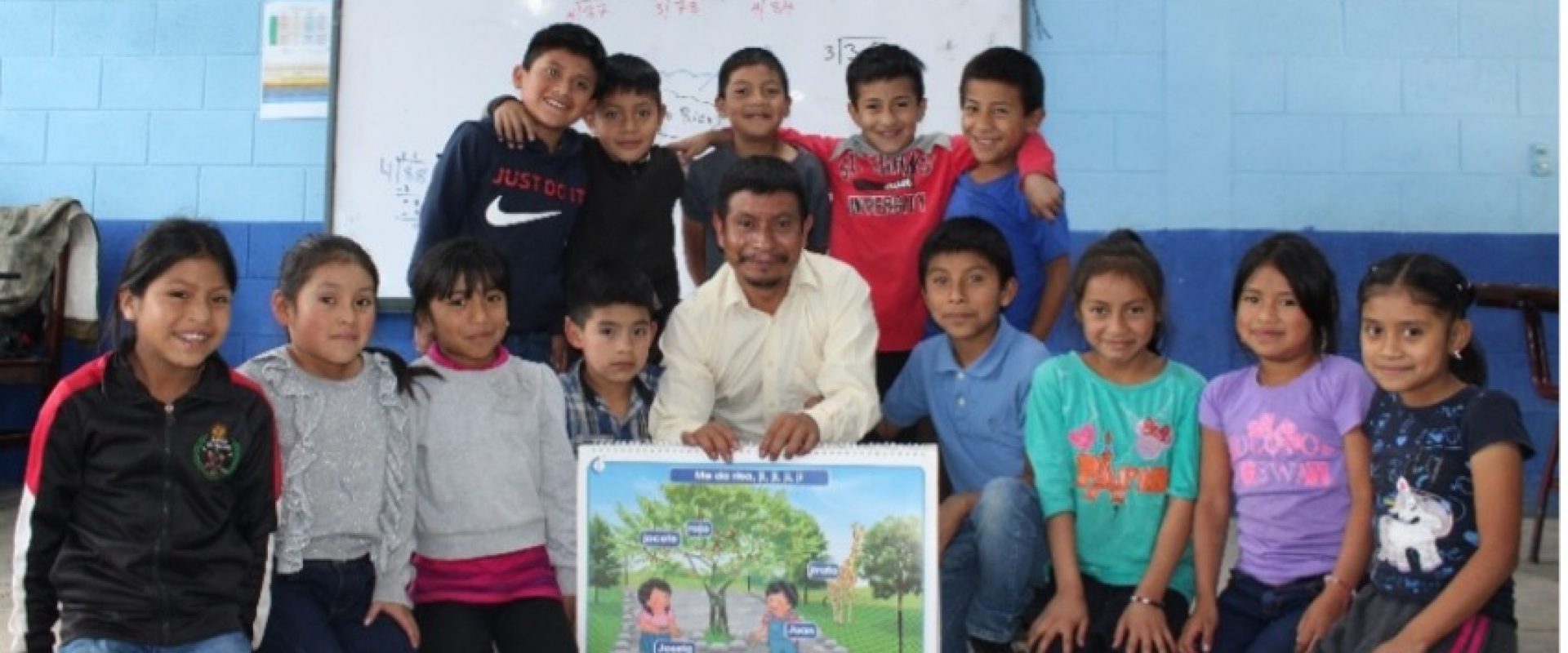
Juan Marroquín still remembers what it was like to teach in “una champita”—a little hut made of wooden planks and metal sheets. “It wasn’t dignified to teach like that,” he recalls.
Today, Juan teaches second and third grade in a classroom built by School the World, and the difference isn’t just about comfort—it’s about what becomes possible when teachers and students have a space worthy of the learning happening inside.
The transformation Juan describes isn’t unique. Across rural Guatemalan communities, School the World (STW) has turned makeshift structures into proper schools, and the impact goes far beyond aesthetics.
Alicia Tzunún González taught for years in a classroom of tabla y lámina—wooden boards and metal sheets. “I feel very happy as a teacher to give my classes in a place in good condition,” she says now. “Thanks to School the World, today I give my classes in a dignified place, with adequate space to carry out my activities with my children so they can learn in the best way.”
That word—dignified—appears repeatedly in teacher testimonials. It speaks to something fundamental: teachers know they deserve professional workspaces, and students deserve learning environments that signal their education matters.
When School the World built three new classrooms for Juan’s school, along with a play area, kitchen, bathrooms, gate, and fresh paint, he says it “changed the school 100%.”
But the changes weren’t just visual. The gate, for instance, solved a practical problem that had disrupted learning daily. “With the gate, the children no longer leave, nor do dogs and other animals enter, because they used to eat the children’s food in the kitchen and when they entered the classrooms,” Juan explains.
Director Marco Antonio Figueroa emphasizes how infrastructure improvements create “a safe and welcoming learning environment for our students.” Safety and welcome aren’t luxuries—they’re prerequisites for learning.
For Ana Isabel Gómez, a 21-year-old director and tutor, the classroom design enables her teaching approach. “I work with young children and I like to sing and dance with them. We have space to move around!” she says of the STW-built classrooms. “They’re spacious, colorful, and with very good lighting.”
These design elements—space, color, natural light—aren’t decorative choices. They’re pedagogical tools. Young children learn through movement and play. Teachers need room to arrange students in groups, create learning stations, and adapt their spaces to different activities.
In cramped, dark sheds made of scrap materials, these teaching methods simply aren’t possible. In well-designed classrooms, they become natural.
What emerges from these testimonials is that classrooms don’t function in isolation. They’re part of an ecosystem that includes books, materials, training, and ongoing support.
Director Roberto Suy connects the infrastructure to the learning outcomes: “Thank you STW for the three classrooms, kitchen, bathrooms, and books! Reading changes a student’s life.” The classrooms provide the space, but the books and materials make that space productive.
Fredy Cabrera, both a teacher and administrative coordinator, emphasizes this connection: “We’ve learned how important it is to have a reading corner, adequate space, decoration, and to teach our students to be organized and take care of books.”
The physical space teaches its own lessons—about organization, care for shared resources, and the value placed on education.
When teachers like Juan and Alicia use the word “dignified,” they’re making a statement about professional respect and student worth. A champita says education is an afterthought, something that happens in leftover spaces with leftover materials. A proper classroom says this work matters, these children matter, this community’s future matters.
Juan puts it plainly: “The school isn’t the second home for children, it’s the first! That’s why I really enjoy seeing them happy, eager to study and better themselves in life.”
This inversion—school as first home rather than second—reflects a reality in many rural communities where school provides stability, safety, meals, and opportunity that may be scarce elsewhere. The physical environment sends a message about what children can expect and aspire to.
Director Aurelia López, reflecting on her school’s classrooms, emphasizes the continuity they provide: “The classrooms you built for us have helped us for many years to have a safe place to teach the children.”
Durability matters. These aren’t temporary fixes or structures that will need replacing in a few years. They’re investments in the long-term educational capacity of communities.
For Juan, the gratitude is deeply personal: “When I came to work here, the school was a shed, with canvas and metal sheets, like a little hut… until STW came to our community, and changed all our lives. Now the school has a different appearance… Thank you STW for so much help! I will always be very grateful to you.”
What’s clear from these testimonials is that construction projects aren’t just about buildings—they’re about possibility. They’re about teachers who can finally implement the creative, active teaching methods they’ve learned. They’re about students who have room to move, light to read by, and walls that keep out both weather and wandering animals.
They’re about communities that see their children’s education taken seriously, with infrastructure that matches the importance of the work happening inside.
As Juan concludes: “All the support gives the school a different look and it looks beautiful, welcoming, with a pleasant environment, with quality and safety for the children.”
Beautiful. Welcoming. Quality. Safety. These aren’t extras in education—they’re foundations. And in communities across rural Guatemala, School the World is helping lay those foundations, one dignified classroom at a time.